•
17 Years SEO Experience (since 2009)
•
Scottsdale, AZ
•
Updated June 26, 2026
⚡ THE SHORT VERSION
No. AI has not replaced Google search.
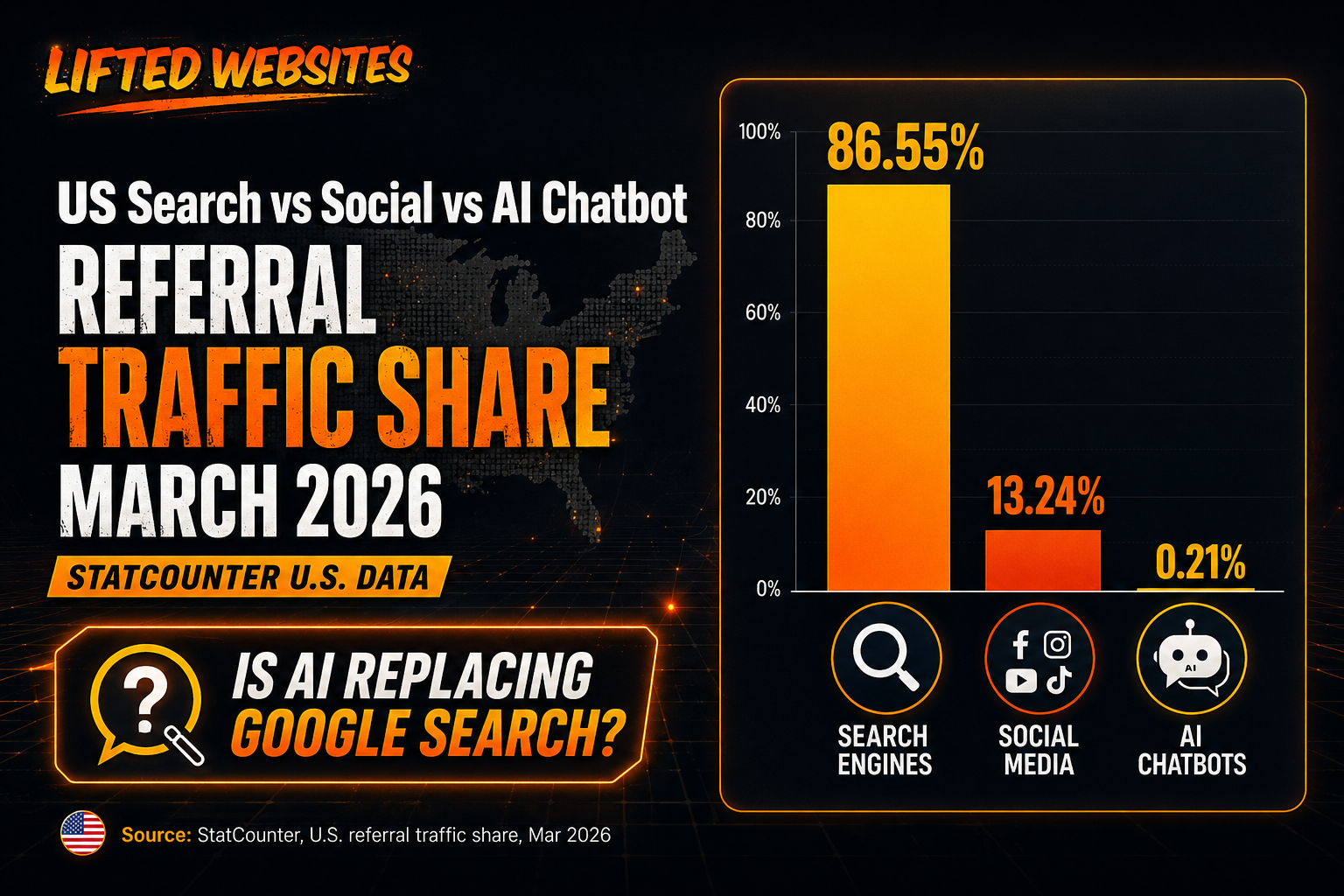
In March 2026, search engines drove 86.55% of all U.S. website referral traffic. AI chatbots drove 0.21% (StatCounter). That is not a typo. Among Americans, 95%+ still use traditional search every month, a number that has barely moved in 2.5 years even as AI tool adoption nearly quintupled.
The honest part: AI is changing search. Just not the way the headline claims. The shift is happening inside Google, through AI Overviews, not because buyers left for ChatGPT. Win Google first. Then add AI engines as a second layer.
A client’s CCO came back from a conference with a line that’s now everywhere: it’s no longer enough to rank on Google because people use AI instead of search engines. It sounds right. It feels true. So we pulled the live, third-party data to check it. Here is what the numbers actually say in 2026, with every source named so you can verify it yourself.
Is AI replacing Google search? Live data says no
The cleanest way to answer this is to measure where website visits actually come from. StatCounter tracks this across more than 3 billion monthly page views using tracking code installed on real sites. It reports the share of referral traffic by channel. For the United States in March 2026, the split looks like this:
| Channel | U.S. referral share (Mar 2026) |
|---|---|
| Search engines | 86.55% |
| Social media | 13.24% |
| AI chatbots | 0.21% |
Narrow it to a head-to-head and the gap is wider. In May 2026, comparing only traffic referred by Google versus ChatGPT in the U.S., Google sent 99.84% and ChatGPT sent 0.16%. You can watch both of these update in near-real time on StatCounter’s live dashboard. This is the number that matters for a business, because referral traffic is what turns into calls, forms, and revenue.
Google vs ChatGPT: the real scale gap
Usage and referral traffic are different things, so let’s look at usage too. SparkToro and clickstream firm Datos (a Semrush company) ran the apples-to-apples comparison. Google disclosed more than 5 trillion searches in 2024, around 14 billion per day. ChatGPT handles roughly 37.5 million search-like prompts per day once you strip out the writing, coding, and brainstorming it’s mostly used for.
And Google isn’t shrinking. On Alphabet’s most recent earnings call, Sundar Pichai said Search had more usage than ever before. Google’s search volume grew roughly 21% from 2023 to 2024. The pie got bigger and AI took most of the new slice. ChatGPT is real and growing fast. It is not, by any measured metric, replacing Google.
The full dataset behind this comparison, with chatbot market share by tracker and our own Q3 2026 call-source numbers, is in our AI search statistics for 2026.
The part of the warning that is true
Here’s where the conference comment has a point worth taking seriously. Organic clicks really are getting harder to earn. But the cause is Google, not ChatGPT.
Pew Research Center tracked the actual browsing of 900 U.S. adults across 68,879 searches. When a Google AI Overview appeared, users clicked a normal result just 8% of the time, versus 15% when no summary showed. Only 1% clicked a link inside the AI summary itself. Separately, zero-click searches rose from 56% to 69% after AI Overviews launched (Similarweb).
Read that carefully. The traffic isn’t leaving for a different platform. Google is answering more questions on its own results page and keeping the visit. That’s why some sites see organic clicks slipping while their Google rankings look fine. The fix isn’t to abandon Google. It’s to win the AI Overview slot and the standard result, because being cited inside the overview is now part of ranking. You can read the full Pew Research study here.
Do people actually leave Google for AI?
The substitution story is the weakest part of the AI-kills-search narrative. The clickstream data points the other way:
- 95%+ of Americans still use traditional search engines every month, down less than 1% over 2.5 years, while AI tool use grew from 8% to 38% (SparkToro / Datos).
- 99% of AI-platform users also keep using traditional search (Datos). Almost nobody picks one.
- Adopting ChatGPT actually raises a person’s Google searches, and they stay higher months later (Semrush, from 260 billion rows of clickstream). ChatGPT is expanding total search, not draining Google.
- Only ~23 million people worldwide use ChatGPT exclusively; 95% of ChatGPT users still use Google (Similarweb).
Where AI search matters more, and less, by business type
National averages hide the part you actually care about: your business. We run Local, National, B2B, and Ecommerce SEO campaigns and watch every lead through CallRail call tracking. The pattern is consistent, and it differs by category.
Local service businesses: AI barely touches this. “Plumber near me” and “emergency HVAC” resolve in Google’s local pack and Maps, where AI chatbots have thin coverage. Across our local clients, 90%+ of tracked leads still source from Google, month after month.
National and B2B: More of the early research phase now happens in ChatGPT, Perplexity, and Gemini. Buyers may discover you there, then convert through a Google search later. AI visibility matters earlier in this funnel, but Google still closes the lead.
Ecommerce: This is where AI bites soonest. Product discovery increasingly surfaces inside AI answers and AI shopping features. Transactional clicks still flow to Google and Amazon, but generative engine optimization earns its budget faster here than in local.
So the conference comment is roughly right for one slice of the market and roughly wrong for another. If you sell locally, the AI panic is mostly noise. If you sell products nationally, it’s a real signal to act on now.
What you should actually do in 2026
1. Keep winning Google. It is still where 86%+ of referral traffic and the large majority of real leads come from.
2. Win Google’s AI surfaces. Answer-first content, clean schema, and citable facts get you into AI Overviews and AI Mode, which is where the clicks are quietly going.
3. Add GEO as a second layer, weighted to your business. Heavier for ecommerce and national B2B, lighter for hyper-local service work.
4. Measure leads, not vanity metrics. Track lead source with call tracking. Decide where AI deserves budget from your own numbers, not a headline.
SEO is not dead. It got wider. The smart move in 2026 is to be the answer everywhere your buyer looks, starting with the place that still pays the bills.
Frequently asked questions
Is AI replacing Google search in 2026?
No. In March 2026, search engines drove 86.55% of U.S. website referral traffic versus 0.21% for AI chatbots (StatCounter). Google still handles roughly 373× more search-like queries per day than ChatGPT (SparkToro / Datos).
How many people use ChatGPT instead of Google?
Almost none use it exclusively. About 95% of ChatGPT users also use Google, and only an estimated 23 million people worldwide rely on ChatGPT alone (Similarweb). 99% of AI-platform users still use traditional search (Datos).
Is SEO dead because of AI?
No. The bigger change is Google’s own AI Overviews keeping users on the results page, which lowered click rates from 15% to 8% (Pew Research). The response is to win AI Overviews and add generative engine optimization, not to drop SEO.
Does AI search matter more for ecommerce than local SEO?
Yes. Product discovery increasingly appears in AI answers, so ecommerce and national brands should invest in AI visibility sooner. Local service businesses still convert overwhelmingly through Google’s local pack and Maps, where AI coverage is thin.
Should I still invest in Google SEO or switch to AI optimization?
Invest in both, weighted toward Google. Google still drives the large majority of leads, so it comes first. Add AI engine optimization as a second layer, sized to how research-heavy and product-driven your category is.
Want to know where YOUR leads actually come from?
We’ll show you a live CallRail breakdown of Google vs AI lead sources for your business, and build a plan that wins both. 17 years of SEO, since 2009, based in Scottsdale.
📞 Or call us directly: (888) 863-7421 | 6815 E Camelback Rd, Scottsdale, AZ 85251