Most AI search statistics pages give one number per question. The trackers do not agree with each other, though. ChatGPT’s market share is 38.7% or 80.5% depending on whether you count phone users or clicks sent to websites, and both figures are correct.
This page puts every major measure side by side, dates each one, and links to the live source so you can check the current figure. It also adds something the public trackers cannot: call and traffic data from the businesses we work with.
AI search statistics at a glance
- ChatGPT holds 55.5% of AI chatbot web traffic worldwide, Gemini 25.6% and Claude 9.3% (Similarweb, August 2026). A year earlier ChatGPT held 73.3%.
- Google handles 73.7% of US desktop searches and all AI tools combined handle 3.2%, measured across 41 major sites (SparkToro and Datos, Q4 2025).
- About 68% of US Google searches end without a click (SparkToro, January to April 2026).
- 45% of US consumers used an AI tool for local business recommendations in the past year, up from 6% (BrightLocal, 2026). 75% of AI users then go to Google to verify.
- In our own Q3 2026 data, AI assistants produced 1.4% of 4,555 tracked phone calls and 0.35% of 900,345 website sessions. Google produced 70.5% of the calls.
Five rules for reading any AI search statistic
The percentages on this page will move every month. These five rules are the stable part. Each one explains a group of numbers below, and each will still apply after the next refresh.
AI chatbot market share by assistant
Data period: August 2026 (worldwide), May 2026 (United States and visit counts) • Last verified: October 2, 2026
As of August 2026, ChatGPT holds 55.5% of worldwide AI chatbot web traffic, Google Gemini holds 25.6%, and Anthropic’s Claude holds 9.3%, according to Similarweb. DeepSeek (3.4%), Grok (2.4%), Microsoft Copilot (1.6%), and Perplexity (0.9%) are the next four. Similarweb’s basket is slightly wider than these seven, so the figures sum to 98.7%.
Source: Similarweb Gen AI traffic share tracker, August 2026. Web visits only; apps and API use are not counted. Chart by Lifted Websites, free to reuse with a link to this page.
| Assistant | Worldwide share, Aug 2026 | A year earlier | US share, May 2026 | Monthly web visits, May 2026 | Visits, year over year |
|---|---|---|---|---|---|
| ChatGPT | 55.5% | 73.3% | 58.3% | 5.6 billion | +2% |
| Gemini | 25.6% | 12.9% | 19.3% | 2.9 billion | +450% |
| Claude | 9.3% | 1.9% | 13.4% | 952.6 million | +855% |
| DeepSeek | 3.4% | 4.0% | 1.2% | 430.4 million | -1% |
| Grok | 2.4% | 2.6% | 3.4% | 244.9 million | +37% |
| Copilot | 1.6% | 2.0% | 2.8% | 131.6 million | +42% |
| Perplexity | 0.9% | 2.0% | 1.6% | 138.1 million | +9% |
Sources: worldwide share from Similarweb, reported by The Decoder. US share, visit counts, and growth from Similarweb data published by Momentic.
Three details sit behind the headline. ChatGPT is not shrinking. Its web visits were flat at about 5.6 billion a month, and OpenAI reported 900 million weekly active users in February 2026. It lost share because the category grew 49% in a year, from 6.96 billion to 10.40 billion monthly visits. Claude is the fastest grower, with visits up 855% year over year to 952.6 million, and it has the lowest bounce rate of the seven at 26%. The US ranking is different. Claude holds 13.4% of US visits against 9.3% worldwide, while Gemini is weaker in the US than abroad.
Why AI market share numbers disagree
Data period: March to September 2026, depending on the tracker • Last verified: October 2, 2026
ChatGPT’s reported market share ranges from 38.7% to 80.5% across public trackers in 2026 because each tracker counts something different. App panels count people, traffic panels count website visits, and StatCounter counts clicks sent out to other websites. Every figure in the table below is accurate for what it measures.
Sources: StatCounter, Similarweb, Momentic, First Page Sage, Sensor Tower, Apptopia, and Lifted Websites first-party data. Full figures in the table below. Chart by Lifted Websites, free to reuse with a link to this page.
| Tracker | What it counts | Where and when | ChatGPT | Gemini | Claude |
|---|---|---|---|---|---|
| StatCounter | Referrals sent from AI chatbots to websites | Worldwide, Sept 2026 | 80.48% | 10.91% | 0.95% |
| StatCounter | Referrals sent from AI chatbots to websites | United States, Sept 2026 | 75.17% | 13.26% | 1.81% |
| Similarweb | Visits to each assistant’s website | Worldwide, Aug 2026 | 55.5% | 25.6% | 9.3% |
| Similarweb (via Momentic) | Visits to each assistant’s website | United States, May 2026 | 58.3% | 19.3% | 13.4% |
| First Page Sage | Estimated monthly active users, web and mobile | United States, Sept 2026 | 52.1% | 26.9% | 10.6% |
| Sensor Tower | AI assistant app users | Worldwide, end of May 2026 | 46.4% | 27.7% | 10.3% |
| Apptopia | Daily active users, top seven mobile apps | United States, March 2026 | 38.7% | about 25% | about 10% |
| Lifted Websites | AI-referred sessions on 14 websites (Google Analytics) | Mostly United States, Q3 2026 | 82.8% | 12.1% | 1.9% |
The pattern is consistent. On every usage measure, ChatGPT sits between 38.7% and 58.3%, Gemini between a fifth and a quarter, and Claude near a tenth. On every referral measure, ChatGPT is above 75% and Claude is under 2%. Our own analytics match StatCounter far more closely than they match the usage trackers, which is what you would expect: both count clicks that reach a website.
First Page Sage notes that its ChatGPT figure also counts Bing Copilot. Apptopia publishes Gemini and Claude as rounded figures.
💡 Which number to use
- Deciding where to monitor your brand: use usage share. Gemini and Claude are a third of the audience.
- Forecasting traffic from AI: use referral share. Plan around ChatGPT.
- Selling to developers or enterprise buyers: use enterprise share, below.
LLM market share: consumer use versus enterprise spend
Enterprise LLM market share is a separate ranking with a different leader. Menlo Ventures estimated in December 2025 that Anthropic held 40% of enterprise LLM API spend, OpenAI 27%, Google 21%, and all other providers 12%, based on a survey of about 500 US enterprise decision-makers. Anthropic’s share was 12% in 2023; OpenAI’s was 50%. Menlo Ventures is an investor in Anthropic, which is worth knowing when you read its figures.
Anthropic is also moving Claude from answering questions to doing the work. On October 21, 2026 it opened a waitlist for Claude Duet, a proactive agent for US Pro and Max subscribers that briefs users each morning and works across their connected apps.
So the question “who leads the LLM market” has three honest answers: ChatGPT leads consumer usage, ChatGPT leads referrals by a wider margin, and Anthropic leads enterprise API spend.
How AI chatbot market share has changed
Data period: February 2025 to May 2026, quarterly • Last verified: October 2, 2026
ChatGPT’s share of worldwide AI chatbot web visits fell from 76.5% in February 2025 to 53.9% in May 2026, while Gemini rose from 5.6% to 27.9% and Claude from 1.4% to 9.2%, according to Similarweb data published by Momentic.
Source: Similarweb data published by Momentic. Chart by Lifted Websites, free to reuse with a link to this page.
| Assistant | Feb 2025 | May 2025 | Aug 2025 | Nov 2025 | Feb 2026 | May 2026 |
|---|---|---|---|---|---|---|
| ChatGPT | 76.5% | 79.0% | 78.1% | 70.3% | 62.7% | 53.9% |
| Gemini | 5.6% | 7.6% | 9.7% | 17.0% | 24.4% | 27.9% |
| Claude | 1.4% | 1.4% | 2.0% | 2.2% | 3.4% | 9.2% |
| DeepSeek | 12.1% | 6.3% | 4.3% | 4.2% | 3.2% | 4.1% |
| Grok | 1.0% | 2.6% | 2.6% | 2.8% | 3.5% | 2.4% |
| Perplexity | 2.2% | 1.8% | 2.0% | 2.3% | 1.8% | 1.3% |
| Copilot | 1.3% | 1.3% | 1.3% | 1.3% | 1.1% | 1.3% |
Claude nearly tripled its share in a single quarter, from 3.4% in February 2026 to 9.2% in May. Since May the movement has slowed. Similarweb’s own tracker put ChatGPT back at 55.5% and Gemini at 25.6% in August. That tracker uses a slightly different basket, so read it as a direction and not as a seventh point on this chart.
AI vs Google: search volume and clicks
Data period: 2025 volume estimates, Q4 2025 share of search, September 2026 referrals • Last verified: October 2, 2026
Google processes about 13.7 billion searches per day. ChatGPT processed about 2.5 billion prompts per day as of July 2025, which is 18% of Google’s volume, but only an estimated 66 million to 600 million of those prompts are search-like. That puts ChatGPT’s search activity at roughly 0.5% to 4.4% of Google’s.
Sources: Ahrefs for Google volume, ChatGPT prompts (July 2025) and the pure-search estimate; SparkToro via Search Engine Land for the 66 million search-like estimate. Chart by Lifted Websites, free to reuse with a link to this page.
Share of search tells the same story from a different angle. SparkToro and Datos tracked where US desktop searches happen across 41 websites in Q4 2025. Google had 73.7%. Every AI tool combined had 3.2%.
Source: SparkToro and Datos. Google and AI figures as published; traditional search engines total about 80%. Chart by Lifted Websites, free to reuse with a link to this page.
Referral traffic is more lopsided still. In September 2026, search engines sent 86.25% of the referral traffic StatCounter measures to US websites, social media sent 13.56%, and AI chatbots sent 0.19% (StatCounter).
The bigger change is happening inside Google
AI has changed search mostly through Google’s own results page, where AI Overviews answer the question before anyone clicks. The zero-click numbers:
- About 68% of US Google searches ended without a click from January to April 2026, per SparkToro. The 32% that did click includes clicks to Google’s own properties and to ads. Its 2024 study with Datos put zero-click searches at about 60%.
- AI Overviews appear on more than 20% of Google searches by Ahrefs data cited by SparkToro, and on more than 40% of US searches by Similarweb.
- Click-through rate (CTR) drops by nearly 60% when an AI Overview is present (Ahrefs, cited by SparkToro).
- Google AI Mode handled 0.34% of searches from January to April 2026 (SparkToro). It is not yet the cause of the click decline.
- About 80% of consumers rely on zero-click results in at least 40% of their searches, and about 60% of searches end without a visit to another site, per Bain & Company (survey of 1,117 consumers, December 2024).
If you want the longer argument on this question, we wrote it up in Is AI replacing Google search?
What AI assistants send to real businesses: our Q3 2026 data
Data period: July 1 to September 30, 2026 • Last verified: October 2, 2026
Across 4,555 inbound phone calls tracked in CallRail for the businesses Lifted Websites works with, 70.5% came from Google and 1.4% came from AI assistants between July 1 and September 30, 2026. ChatGPT produced 56 of the 62 AI-sourced calls.
Source: Lifted Websites, CallRail. Google includes Google Ads (34.1%) and organic search plus Google Business Profile (36.4%). Other search engines are Bing, Yahoo and DuckDuckGo. AI assistants are ChatGPT, Copilot, Perplexity and Gemini. Chart by Lifted Websites, free to reuse with a link to this page.
Website traffic shows the same scale. Across 14 websites with Google Analytics data, AI assistants referred 3,194 of 900,345 sessions, or 0.35%. The split by business type surprised us. On 11 local service business sites, AI referred 0.88% of sessions (255 of 29,001). On three ecommerce and industrial sites it referred 0.34% (2,939 of 871,344). Individual local sites ranged from 0.3% to 3.1%.
| Measure | Total | From AI assistants | AI share |
|---|---|---|---|
| Inbound phone calls (CallRail) | 4,555 | 62 | 1.4% |
| First-time callers (CallRail) | 2,599 | 51 | 2.0% |
| Website sessions, all 14 sites (GA4) | 900,345 | 3,194 | 0.35% |
| Website sessions, 11 local service sites | 29,001 | 255 | 0.88% |
| Website sessions, 3 ecommerce and industrial sites | 871,344 | 2,939 | 0.34% |
Which assistant sends the traffic
ChatGPT sent 82.8% of the AI-referred sessions in our data, Gemini 12.1%, Claude 1.9%, Copilot 1.4%, and Perplexity 1.2%. Compare that with usage. Gemini has 25.6% of worldwide AI chatbot visits but sent 12.1% of our referrals. Claude has 9.3% of visits and sent 1.9%. The gap holds on US figures too, where Gemini has 19.3% of visits and Claude 13.4%.
Sources: Similarweb; Lifted Websites, Google Analytics 4, 3,194 AI-referred sessions. Chart by Lifted Websites, free to reuse with a link to this page.
One quality signal stood out. 51 of the 62 AI-sourced calls (82%) were first-time callers, against 57% of all calls. A lead from an AI assistant is more likely to be a new customer than a returning one.
⚠️ What this data cannot tell you
This is a small, uneven sample. It covers US businesses we work with, the mix includes accounts running Google Ads, and two industrial ecommerce stores account for most of the sessions. Sixty-two calls is enough to show scale and not enough to split by trade.
AI figures are also a floor. A visit from an AI app that passes no referrer is recorded as direct, and someone who gets a recommendation in ChatGPT and then searches the business name on Google is recorded as a Google lead. Nobody can measure that second group yet, including us.
AI in local search statistics
Data period: 2026 surveys by BrightLocal and Yext; SOCi index, January 2026 • Last verified: October 2, 2026
45% of US consumers used ChatGPT or another generative AI tool for local business recommendations in the past year, up from 6% a year earlier, according to BrightLocal‘s 2026 Local Consumer Review Survey of 1,002 adults. Most do not act on the AI answer alone. BrightLocal data on 673 AI users shows that 18% contact the recommended business directly and 75% go to Google to verify first.
Source: BrightLocal Consumer Search Behavior Survey 2026, 1,227 US consumers. Chart by Lifted Websites, free to reuse with a link to this page.
| Local search statistic | Figure | Source |
|---|---|---|
| Used generative AI for local business recommendations in the past year | 45% (6% in 2025) | BrightLocal |
| Used AI to search for a local business in the past month | 47% of US adults | Yext |
| Started their most recent local search on Google Search | 52% | BrightLocal |
| Started on Google Maps; started on social media | 9% each | BrightLocal |
| Local searches that start on a mobile device | 73% | BrightLocal |
| AI users who take at least one verification step before acting | More than 93% | Yext |
| AI users who go to Google to verify a recommendation | 75% | BrightLocal |
| AI users who contact the recommended business directly | 18% | BrightLocal |
| Active AI users who trust AI recommendations | 63% | BrightLocal |
| Adults aged 30 to 44 who use AI for local recommendations | 64% | BrightLocal |
| Multi-location brand locations that ChatGPT recommends | 1.2% | SOCi |
| Same locations appearing in Google’s local 3-pack | 35.9% on average | SOCi |
| Consumers who read reviews for local businesses | 97% | BrightLocal |
The SOCi figures deserve a second look. Its 2026 Local Visibility Index covered more than 350,000 locations across 2,751 multi-location brands and found ChatGPT about 30 times more selective than Google’s local pack. Locations that ChatGPT did recommend averaged a 4.3-star rating. BrightLocal reports that the sources AI most often cites for local businesses are Google Business Profile, Yelp, and Facebook.
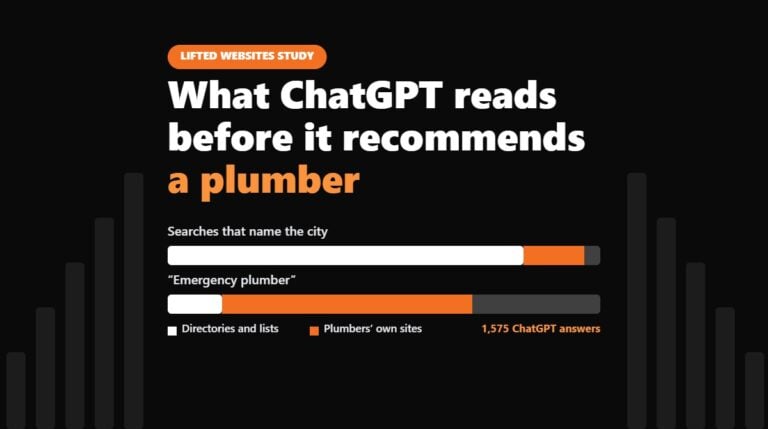
Our own scan shows how much the cited sources depend on the search. In October 2026 we logged the sources behind 1,575 ChatGPT answers to seven plumber searches across one metro. For searches that named the city, 82.2% of the cited links went to directories and “best plumber” lists and 14.1% to plumbing companies’ own websites. For “emergency plumber”, 57.9% went to plumbing companies’ own websites. Yelp supplied 0.9% of all 38,164 links. That is one trade in one metro, so read it as a case, not a benchmark. The method and tables are in how to get ChatGPT to recommend your business.
For the wider picture on maps, reviews, and mobile, see our local SEO statistics page.
What people use ChatGPT and Claude for
Data period: ChatGPT through mid-2025 (OpenAI); Claude May 2026 (Anthropic Economic Index) • Last verified: October 2, 2026
ChatGPT is used mostly for practical guidance (28.3% of messages), writing (28.1%), and seeking information (21.3%), per OpenAI‘s study of consumer use through mid-2025. Claude is used most for content creation (22.7% of conversations), education (13.2%), software development (11.5%), and research (10.9%), per Anthropic‘s May 2026 Economic Index.
Source: OpenAI and NBER. Topic shares as reported by co-author David Deming and the American Psychological Association. Chart by Lifted Websites, free to reuse with a link to this page.
Source: Anthropic Economic Index, CC BY 4.0. Chart by Lifted Websites, free to reuse with a link to this page.
| ChatGPT | Claude | |
|---|---|---|
| Work-related share of use | About 30% | 43.4% |
| Personal or non-work share | About 70% | 40.2%, plus 16.5% coursework |
| Top use | Practical guidance, 28.3% | Content creation, 22.7% |
| Search-like use | Seeking information, 21.3% | Top two work tasks are information lookups, 5.0% and 3.7% of conversations |
| Programming | 4.2% of messages | Software development, 11.5% of conversations |
| Data period | Through July 2025 | May 2026 |
For anyone thinking about search, the Claude task data is the interesting part. The two most common work tasks are both information lookups, and the third is recommending products and services (2.3% of conversations). Those are jobs a search engine used to do.
Two cautions. OpenAI and Anthropic use different category schemes and different time periods, so the two charts are not a like-for-like comparison. And the Claude figures describe conversations matched to topics and tasks. They do not describe who the users are or what jobs they hold.
How many people use AI, and how many pay for it
Data period: Use: November 2025 (Federal Reserve). Paid subscriptions: May 2026 (PNC) • Last verified: October 7, 2026
About 41% of the US workforce used generative AI for work as of November 2025, and about 50% of the population used it outside work, according to a Federal Reserve note built on the Real-Time Population Survey. Paying is far rarer. PNC found that 2.2% of its households paid for a generative AI subscription in May 2026.
Sources: use from the Federal Reserve (Real-Time Population Survey, November 2025). Subscriptions from PNC Economics (card data for PNC retail customers, May 2026). Chart by Lifted Websites, free to reuse with a link to this page.
Households that do pay spend about $31 a month, up from about $22 two years earlier. PNC’s breakdown shows who they are:
| Group | Share paying for an AI subscription, May 2026 |
|---|---|
| All PNC households | 2.2% |
| Higher-income households | More than 4% |
| Middle-income households | About 2% |
| Lower-income households | Less than 1% |
| Gen Z, Millennials, and Gen X | 3% to 3.5% each |
| Boomers | About 1% |
Businesses pay more readily than households. 56% of the roughly 70,000 companies in Ramp’s spending data paid for an AI product in August 2026, according to the Ramp AI Index as reported by TechCrunch. Ramp’s customers are not a cross-section of US business, and the Census Bureau’s wider survey puts AI use at about 18% of all US firms at the end of 2025. Among S&P 500 companies, a16z counts nearly 30% reporting a quantifiable impact from AI and about 2% reporting a metric they track.
💡 Why this belongs on a search statistics page
Rule 1 applies here too. “Uses AI” and “pays for AI” are different counts, and they differ by a factor of about twenty. The gap suggests most personal AI use happens on free plans. That fits the referral data above: AI assistants are widely used, and they still send a small share of clicks and calls.
Three cautions. The PNC figure covers PNC’s own retail customers, not all US households, and PNC does not publish how it identifies an AI payment. Card data may miss a seat paid by an employer or a plan billed through an app store. The Federal Reserve figures are survey answers about use, so the two sets of numbers are not a like-for-like comparison. And a16z, whose State of Markets report brought the 2% figure wide attention, invests in AI companies.
AI usage by state
Data period: May 2026 snapshot, Claude usage only • Last verified: October 2, 2026
Washington, D.C. (3.32), California (1.62), New York (1.55), Washington (1.51), and Massachusetts (1.42) have the highest Claude usage relative to working-age population in Anthropic‘s May 2026 Economic Index. West Virginia (0.25) and Mississippi (0.28) have the lowest.
The Anthropic Usage Index is a state’s share of Claude usage divided by its share of the US working-age population. A score of 1.0 means usage is exactly proportional to population. A score of 2.0 means twice as much usage as population alone would predict.
Source: Anthropic Economic Index, published under CC BY 4.0. Chart by Lifted Websites, free to reuse with a link to this page.
All 50 states and D.C., ranked
Sixteen states and Washington, D.C. are at or above 1.0. Arizona, where we are based, scores 0.95, level with Texas and just under the national average. New Jersey scores 1.02 and Pennsylvania 0.80. Florida has the highest share of work-related use of any state (47.9% of conversations), and Iowa the highest share of coursework (14.6%).
Read this map with three limits in mind. It measures Claude only, not ChatGPT or Gemini. Places with small populations swing further in either direction, which is part of why D.C. leads by so much. And it is a single snapshot with no trend, so it cannot show which states are rising. It is not evidence about employment or jobs.
What the numbers mean for a marketing budget
The data supports keeping Google as the primary channel and treating AI visibility as a second, smaller channel that is worth measuring now. Three specifics:
- Keep the ranking work funded. Google produced 70.5% of our tracked calls and AI assistants produced 1.4%. A business that moves its budget from one to the other today is trading a large channel for a small one.
- Fix what AI reads. AI answers about local businesses lean on Google Business Profile, Yelp, and Facebook, and ChatGPT’s picks average 4.3 stars. Accurate listings and recent reviews serve both channels at once. This is most of what generative engine optimization (GEO) means for a local business.
- Track AI as its own source. Build a Google Analytics segment for referrals from chatgpt.com, gemini.google.com, perplexity.ai, claude.ai, and copilot.com, and watch calls by source in your call tracking. You cannot manage a channel you have lumped into “direct.”
One more mechanic is worth knowing. Google’s AI Mode breaks a single question into several sub-queries and assembles an answer from the results, a technique Google calls query fan-out. A page that answers the follow-up questions, with each answer able to stand alone, has more chances to earn citations than a page that only targets the head term. We cover how that works for ChatGPT on our ChatGPT SEO page and across engines on our AI SEO services page.
Methodology and sources
Every figure on this page has a named source, a data period, and a link. Where a number came to us through a secondary report, the table says so. Where two sources disagree, both are shown. Use the source links to check the current figure, since most of these trackers publish monthly.
| Source | What it measures | Period used here | Updated |
|---|---|---|---|
| Similarweb | Share of visits to AI assistant websites, worldwide | August 2026 | Monthly |
| Momentic | Similarweb visit data by assistant, worldwide and US, with quarterly trend | May 2026 | Monthly |
| StatCounter | Share of referrals sent from AI chatbots to websites | September 2026 | Monthly |
| First Page Sage | Estimated US monthly active users, web and mobile | September 2026 | Monthly |
| Sensor Tower | Share of AI assistant app users worldwide, as reported by Tech Insider | End of May 2026 | Annual report |
| Apptopia | Daily active users across the top seven AI chatbot mobile apps, US | March 2026 | Monthly |
| Menlo Ventures | Enterprise LLM API spend, survey of about 500 US enterprise decision-makers | November 2025 | Twice a year |
| SparkToro and Datos | Clickstream panel: where US desktop searches happen across 41 sites | Q4 2025 | Irregular |
| SparkToro | Zero-click rate of US Google searches, from a Similarweb panel | January to April 2026 | Irregular |
| Ahrefs | Google and ChatGPT daily volume, built on Google and OpenAI disclosures | 2025 | Irregular |
| Bain & Company | Consumer survey on zero-click behavior, 1,117 respondents | December 2024 | One-off |
| BrightLocal | US consumer surveys on local search, 1,002 and 1,227 respondents | 2026 | Annual |
| Yext | US consumer survey on search behavior, 1,120 adults | March 2026 | Annual |
| SOCi | Local Visibility Index: 350,000+ locations across 2,751 multi-location brands | January 2026 | Annual |
| OpenAI and NBER | Classified sample of consumer ChatGPT messages | Through July 2025 | One-off |
| Anthropic Economic Index | Claude conversations matched to topics and tasks; usage index by state | May 2026 | Periodic |
| Federal Reserve | FEDS Note on generative AI use at work and outside it (Real-Time Population Survey) and AI use by firms (Census Bureau) | November and December 2025 | Irregular |
| PNC Economics | Share of PNC retail households paying for a generative AI subscription, from card transactions | May 2026 | Monthly |
| Ramp AI Index | Share of about 70,000 Ramp business customers paying for AI products, as reported by TechCrunch | August 2026 | Monthly |
| a16z | State of Markets II: S&P 500 companies reporting an AI impact or a tracked AI metric | First half of 2026 | Twice a year |
| Lifted Websites | CallRail call sources and Google Analytics AI referrals for businesses we work with | Q3 2026 | Quarterly |
How we collected the first-party data
Calls. All inbound calls from July 1 to September 30, 2026 in two agency CallRail accounts, grouped by the source CallRail assigns. We counted “Google Organic,” “Google Ads,” “Google My Business,” and “Google” as Google. We counted the sources CallRail labels SearchGPT, Perplexity, Gemini, and copilot.com as AI assistants. Nothing was excluded.
Sessions. All sessions in the same period for the 14 Google Analytics 4 properties that recorded data, with AI referrals identified by GA4’s AI assistant channel plus a list of known AI referrer domains. Figures are aggregated and anonymized. No individual business is identified.
Update log
Share figures are re-checked each quarter, and the date at the top of the page changes only when the data does. Next scheduled check: January 2027.
🔗 Cite this page
Lifted Websites. “AI Search Statistics 2026.” Data verified October 2, 2026. https://liftedwebsites.com/ai-search-statistics/
Our charts and first-party figures are free to reuse with a link to this page. Third-party figures belong to their sources, so please cite those directly. Anthropic Economic Index data is published under CC BY 4.0. To link to one chart, add its anchor to the URL, for example #chart-tracker-range.
Frequently asked questions
Which AI chatbot has the most market share?
ChatGPT has the most market share on every consumer measure. It holds 55.5% of worldwide AI chatbot web traffic (Similarweb, August 2026), 52.1% of estimated US monthly active users (First Page Sage, September 2026), and 80.5% of AI referral clicks sent to websites (StatCounter, September 2026).
What are the top 5 AI chatbots?
By worldwide web traffic in August 2026, the top five AI chatbots are ChatGPT (55.5%), Google Gemini (25.6%), Claude (9.3%), DeepSeek (3.4%), and Grok (2.4%). Microsoft Copilot (1.6%) and Perplexity (0.9%) follow, according to Similarweb.
Is ChatGPT losing market share?
ChatGPT is losing share but not traffic. Its share of AI chatbot web visits fell from 73.3% to 55.5% in the year to August 2026, while its monthly web visits were flat at about 5.6 billion as of May 2026. Gemini and Claude grew the category around it.
What is Claude’s market share?
Claude holds 9.3% of worldwide AI chatbot web traffic (Similarweb, August 2026), 13.4% of US web visits (May 2026), and 10.3% of AI assistant app users (Sensor Tower, May 2026). Its share of referral clicks sent to websites is much lower, at about 1% to 2%.
Is AI replacing Google search?
AI is not replacing Google search in 2026. Across the 41 major sites SparkToro and Datos track, Google handles 73.7% of US desktop searches and all AI tools combined handle 3.2% (Q4 2025). Search engines send 86.25% of the referral traffic StatCounter measures to US websites and AI chatbots send 0.19% (September 2026).
How many people use AI to find local businesses?
45% of US consumers used a generative AI tool for local business recommendations in the past year, up from 6% the year before (BrightLocal, 2026). A separate Yext survey found 47% of US adults used AI for a local search in the past month. Most verify the answer on Google before acting.
Is it true that most Google searches end without a click?
Yes. SparkToro found that about 68% of US Google searches ended without a click from January to April 2026, up from about 60% in its 2024 study with Datos. SparkToro attributes the rise mainly to AI Overviews.
See what Google and AI say about your business
We check how your business shows up in Google, AI Overviews, ChatGPT, Gemini, and Perplexity, then tell you which fixes come first. Local SEO plans start at $800 per month.
📞 Or call us directly: (888) 863-7421 | 6815 E Camelback Rd, Scottsdale, AZ 85251