GEO means Generative Engine Optimization
GEO is the practice of structuring your website and brand signals so AI tools like ChatGPT, Google AI Overviews, Perplexity, Claude, and Gemini cite or recommend your business in their answers. Traditional SEO earns you a ranked link. GEO earns you a mention inside the answer itself. In 2026, most businesses need both, and the work overlaps more than the hype suggests.
If you searched “geo meaning,” you probably saw the term in a marketing email, a LinkedIn post, or an agency pitch and wanted a straight answer. Here it is: in marketing, GEO stands for Generative Engine Optimization. It is the discipline of getting your business named in AI-generated answers rather than just ranked in a list of blue links. This guide defines GEO in plain English, shows exactly how it differs from SEO, and translates what it means if you run a real business rather than a Fortune 500 marketing department.
What Does GEO Stand For?
GEO has three common meanings, and which one you need depends on where you saw the term. In 2026 marketing conversations, it almost always means Generative Engine Optimization. Here are all three so you can rule out the wrong ones:
| Term | What It Means | Where You See It |
|---|---|---|
| GEO (marketing) | Generative Engine Optimization: earning citations in AI-generated answers | SEO agencies, marketing blogs, LinkedIn |
| Geo (targeting) | Short for “geographic,” as in geotargeting ads or geo-fencing to a location | Google Ads settings, ad platforms |
| Geo- (prefix) | Greek root meaning “earth,” as in geography or geology | Dictionaries, science classes |
The rest of this article covers the first one. If you were looking for geotargeting in Google Ads, that lives in campaign location settings and is a different topic entirely.
GEO Meaning in Marketing: The Plain-English Definition
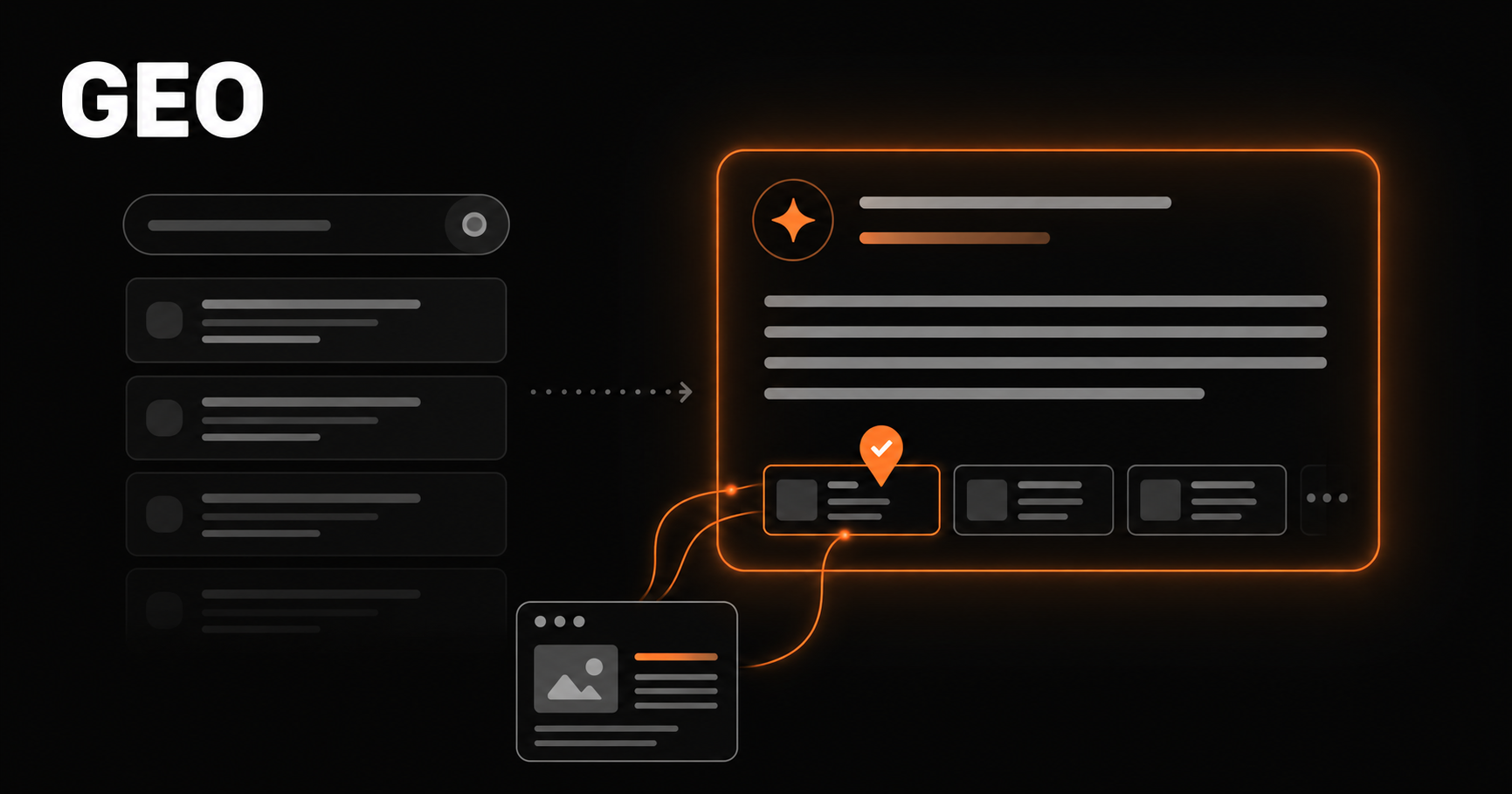
Generative Engine Optimization (GEO) is the process of optimizing your content, entity signals, and online reputation so that AI systems retrieve your information and cite your business when they generate answers. The term comes from a November 2023 academic paper led by Princeton University researchers, “GEO: Generative Engine Optimization”, which tested nine content tactics across thousands of queries to see what made AI engines cite a source more often.
Three tactics from that study produced roughly 30–40% improvements in citation visibility: adding quotations from credible sources, adding statistics, and citing primary sources. Notice what those have in common. Each one raises the factual density of a page. AI retrieval systems reward pages that state verifiable facts plainly, and that finding still drives most legitimate GEO work in 2026.
💡 Why the term exploded in 2025–2026
Google AI Overviews now answer a large share of informational searches directly on the results page, and ChatGPT, Perplexity, and Gemini answer millions of buying-intent questions daily. When the answer engine names five companies and yours is not one of them, you are invisible at the exact moment a buyer decides. GEO is the response to that shift. We cover the broader landscape in our guide to what AI SEO is.
GEO vs SEO: What Is Actually Different?
SEO optimizes for a ranked list of links. GEO optimizes for a position inside the AI’s written answer, where no link list exists. That is the core difference. The inputs overlap heavily; the output you are competing for does not.
| SEO | GEO | |
|---|---|---|
| Goal | Rank a page in search results | Get cited or named inside AI answers |
| Where it shows up | Google and Bing result pages | AI Overviews, ChatGPT, Perplexity, Claude, Gemini |
| Success metric | Rankings, clicks, organic traffic | Citations, brand mentions, AI-referred leads |
| Key levers | Keywords, backlinks, technical health | Factual density, entity clarity, third-party mentions, extractable structure |
| Unit of competition | A page | Your brand as an entity |
⚠️ The honest part most GEO pitches leave out
Google published official documentation in 2026 stating that optimizing for its generative AI features is still SEO. Google is largely right about its own surfaces: AI Overviews pull heavily from content that already ranks. Where GEO earns its keep as a distinct practice is off Google, in ChatGPT (which retrieves through Bing’s index), Perplexity, and Claude, where citation patterns diverge from Google rankings. Anyone selling you GEO as a total replacement for SEO is selling the acronym, not the work.
How Does GEO Work in Practice?
GEO works by making your content easy for AI retrieval systems to find, verify, and quote. When someone asks an AI engine a question, the engine searches an index, pulls candidate pages, and assembles an answer from the passages it trusts most. Four things determine whether your business makes that cut:
- Answer-first structure. Pages that state the answer in the first sentence of each section get extracted. Pages that wind up to the point after three paragraphs of throat-clearing get skipped.
- Factual density. Specific numbers, named sources, dates, and prices give the model verifiable material to quote. Vague claims give it nothing to work with.
- Entity clarity. Your name, address, services, and pricing must be consistent everywhere they appear: your site, your Google Business Profile, directories, and reviews. Conflicting signals lower the model’s confidence in naming you.
- Crawler access. If your robots.txt blocks GPTBot, PerplexityBot, or ClaudeBot, or your key facts live inside images and JavaScript widgets, AI engines cannot retrieve them. This is the most common technical failure we find in AI SEO audits.
There is also a compounding effect worth knowing about. Per Seer Interactive’s 2026 analysis, brands cited in AI Overviews earn roughly 120% more organic clicks per impression than uncited brands on the same queries. Getting named once tends to reinforce the entity signals that get you named again.
What Does GEO Mean for a Local Business?
For a local business, GEO means being the company an AI names when someone asks for a recommendation in your city. Almost everything written about GEO targets SaaS companies and national brands. The local version is more concrete. When a homeowner in Chandler asks ChatGPT “who should I call for a slab leak,” the answer draws on your Google Business Profile, your reviews, your service pages, and mentions of your business on other sites. The businesses that get named are the ones whose information is specific, consistent, and confirmable across all of those sources.
The good news for local companies: the fundamentals overlap almost entirely with strong local SEO. A complete Google Business Profile, steady reviews that mention your services and city, service pages that state what you do and where, and consistent NAP data are simultaneously local SEO signals and GEO signals. You do not need a separate “AI department.” You need the same work done to a higher standard of specificity.
[TJ VOICE SPOT #1 — one short paragraph here: a real client example of an AI-referred lead. See voice pass notes below the code.]
How Much Does GEO Cost?
At Lifted Websites, GEO is built into our SEO plans starting at $800/month rather than sold as a separate line item. That is a deliberate position. Because the inputs overlap so heavily with SEO, splitting them into two invoices mostly benefits the agency. Our Local SEO plan ($800/mo, one Google Business Profile target) includes answer-first content structure, entity cleanup, and AI crawler access checks. Multi-Local Plus ($2,000/mo, up to three Google Business Profiles plus unlimited location pages) and custom plans ($3,000–$10,000+/mo) add citation tracking across AI engines and content built specifically to win AI answers. Full details are on our Generative Engine Optimization services page.
If a vendor quotes you a large standalone “GEO retainer” with no SEO foundation underneath it, ask what specifically they will do that good SEO does not already cover. The answer will tell you a lot. Our ChatGPT SEO services page breaks down the engine-specific work that genuinely goes beyond the basics.
GEO Meaning: Frequently Asked Questions
What does GEO stand for in SEO?
In an SEO context, GEO stands for Generative Engine Optimization: the practice of optimizing content so AI engines like ChatGPT, Google AI Overviews, Perplexity, and Gemini cite your business in their generated answers. It does not mean geographic targeting, which is a separate advertising concept.
Is GEO the same as AEO?
They overlap heavily and are often used interchangeably. AEO (Answer Engine Optimization) traditionally covered featured snippets and voice assistants, while GEO specifically targets generative AI platforms built on large language models. In practice, the same content structure and entity work serves both, so most agencies run them as one program.
Does GEO replace SEO?
No. Google’s own 2026 documentation states that optimizing for its generative AI features is still SEO, and AI Overviews draw heavily from content that already ranks. GEO extends SEO to AI engines outside Google, such as ChatGPT and Perplexity, where citations follow different patterns. Businesses in 2026 need both, and most of the work is shared.
How do I measure GEO results?
Track three things: how often AI engines cite or mention your brand for your core queries (tools like Ahrefs Brand Radar track this), referral traffic arriving from AI platforms in your analytics, and leads that mention finding you through an AI tool. At Lifted Websites we tag AI-referred phone leads in CallRail so clients see them separated from standard organic calls.
Who invented the term GEO?
The term was introduced in a November 2023 research paper by academics from Princeton University, Georgia Tech, the Allen Institute for AI, and IIT Delhi. The paper tested nine optimization tactics and found that adding statistics, quotations, and cited sources improved AI citation visibility by roughly 30–40%.
Want to Know If AI Engines Are Citing You?
We check what ChatGPT, AI Overviews, and Perplexity actually say when someone searches for what you sell — then show you the gap. Free, and it takes one call.
📞 Or call us directly: (888) 863-7421 | 6815 E Camelback Rd, Scottsdale, AZ 85251