Semrush competitors and alternatives for SEO

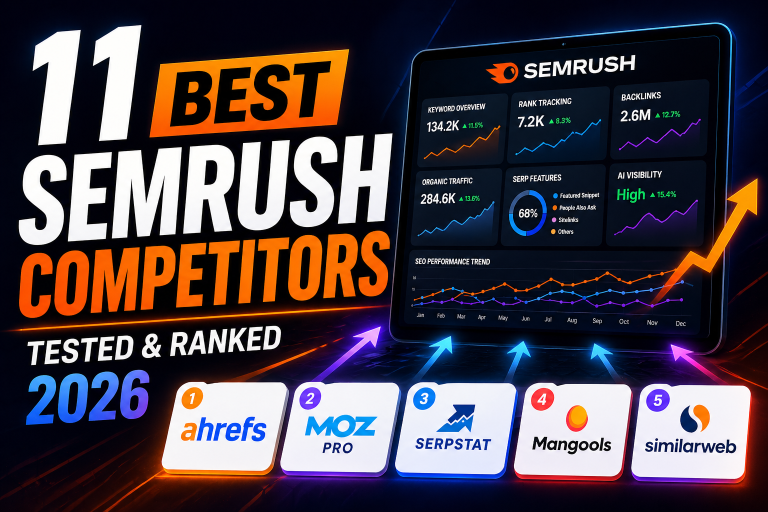
11 Best Semrush Competitors & Alternatives in 2026 (Tested & Ranked)

SHARE:

SEO Tools
12 min read
·
Updated April 2026

The 11 Best Semrush Competitors in 2026 (Tested by an SEO Agency)

Agency Perspective

We run SEO campaigns on more than a dozen tools every week. This is the unfiltered breakdown of which Semrush competitors actually replace it, which ones complement it, and which ones to skip — based on what we use to rank our clients, not affiliate payouts.

Semrush competitors fall into three categories: full-suite platforms that do almost everything Semrush does, specialized tools that beat Semrush at one specific job, and budget options that cover 70% of the work for 20% of the price. The best Semrush competitor for you depends entirely on which of those three buckets matches your workflow.

Semrush still sells more than 117,000 paying subscriptions and pulls in over $400M in annual revenue, so the alternatives aren’t winning by default — they’re winning on price, on data quality, on UX, or on a single feature Semrush still hasn’t nailed. Below is the list ranked the way an agency actually evaluates them, with the trade-offs spelled out.

11
Tools Tested
$0
Cheapest Option
$139
Semrush Pro / mo
3
Categories

Why People Are Looking for Semrush Competitors

The most common reason teams shop Semrush competitors is price: Semrush Pro starts at $139.95/month, Guru is $249.95, and Business is $499.95 — and every one of those plans caps you at a single user without paying extra. For a freelancer, a small in-house team, or a startup running their first SEO play, that math stops working fast.

The second reason is data accuracy. Semrush has the largest keyword database in the industry, but its backlink index has historically lagged behind Ahrefs, and its US search volume estimates are notoriously inflated for branded and long-tail terms. The third reason — and the one we hear most from agency clients in 2026 — is the AI shift. Semrush’s AI Overviews and ChatGPT visibility tooling exist, but tools built AI-first are pulling ahead on citation tracking and prompt-level visibility.

What We Tell Clients

If you’re spending under $300/month on SEO tools and only running campaigns for one or two domains, you almost certainly don’t need Semrush. The right combo of two specialized tools will outperform it for your use case and cost half as much.


Part 1

Full-Suite Semrush Competitors

All-in-one platforms that can replace Semrush across keyword research, backlinks, rank tracking, and audits.

1

Ahrefs — The Direct Competitor

Best Overall

Starts at $129/month. Ahrefs is the most direct full-suite competitor to Semrush, and for backlink analysis it is the industry standard. Their crawler indexes the second-largest live backlink database on the public web, and Site Explorer’s data freshness still beats Semrush by 1–3 days on average.

Where it wins: backlink data, content gap analysis, technical site audits, and Brand Radar (their newer AI visibility tool that tracks how often your brand is cited in LLM responses).

Where it loses: Ahrefs charges per-credit on its lower plans and has no PPC research tools comparable to Semrush’s PLA Research or Advertising Toolkit. If paid media is half your job, Semrush still wins.

2

Moz Pro — The Established Veteran

Best for Beginners

Starts at $49/month. Moz Pro is the gentlest learning curve in the category. The interface is built for people who don’t think in SEO jargon, and Domain Authority — Moz’s metric — is still the most-quoted backlink quality score in client reporting because it’s easier to explain than DR or AS.

Where it wins: on-page graders, local SEO via Moz Local, and the lowest Cost-of-entry of any full-suite tool.

Where it loses: the keyword database is roughly half the size of Semrush’s, and the rank tracker only updates weekly on lower tiers — a deal-breaker for fast-moving SEO campaigns.

3

SE Ranking — Best Price-to-Power Ratio

Best Value

Starts at $65/month. SE Ranking is the closest feature-for-feature replacement for Semrush at half the price. It includes keyword research, on-page audits, backlink monitoring, content marketing tools, and an AI rank tracker that handles SGE and ChatGPT-style results.

Where it wins: the rank tracker is the most accurate sub-$100 tool we’ve tested, and you get unlimited projects on every plan — Semrush caps projects on lower tiers.

Where it loses: the backlink index is smaller, and the UI feels like it was designed by an engineer rather than a marketer.

4

Serpstat — Best for Solo Operators

Starts at $59/month. Serpstat is what Semrush would look like if it were built in 2018 and refused to raise prices. It covers all five core SEO disciplines — keywords, backlinks, rank tracking, audits, content — and includes a clustering tool that’s genuinely better than Semrush’s at scale.

Verdict: if you’re running fewer than 10 client domains and don’t need PPC research, Serpstat does 85% of Semrush for 40% of the cost.


Part 2

Specialized Semrush Competitors

Tools that beat Semrush at one specific job — keyword research, AI search visibility, or technical audits.

5

Mangools (KWFinder) — Best for Keyword Research

Starts at $29/month. Mangools is a five-tool suite anchored by KWFinder, which remains the cleanest interface for finding low-competition long-tail keywords. KWFinder’s keyword difficulty score is calculated differently from Semrush’s and consistently identifies easier opportunities that Semrush flags as too competitive.

Verdict: we keep a Mangools seat alongside enterprise tools specifically for one task — finding the long-tail terms our main tool’s keyword difficulty filter misses. At $29/month, it earns its keep.

6

Screaming Frog — Best for Technical SEO

Free up to 500 URLs, $259/year for unlimited. Screaming Frog SEO Spider is a desktop crawler that diagnoses technical SEO issues at a level no cloud-based tool — including Semrush — can match. It crawls JavaScript rendering, validates structured data against the latest schema, finds orphaned pages, and exports everything to spreadsheets.

Verdict: not a Semrush replacement — a Semrush complement. Every serious technical audit we run starts with Screaming Frog.

7

Surfer SEO — Best for Content Optimization

Starts at $89/month. Surfer is a content optimization tool that scores live SERP competitors and tells you exactly which terms, headings, and structural patterns top-ranking pages use. Semrush’s SEO Writing Assistant does a version of this, but Surfer’s NLP analysis is meaningfully more granular.

Verdict: if your bottleneck is publishing volume, Surfer is the tool that gets writers from “decent draft” to “page-one ready” faster than anything else. We use it on every SEO blog writing project.

8

Ubersuggest — Best Free Semrush Alternative

Free tier available; lifetime deals from $290. Ubersuggest is the most generous free tier among Semrush competitors. The free version handles three searches a day, basic site audits, and rank tracking for up to 25 keywords — enough for a side project or a single landing page.

The catch: the data is noticeably less accurate than the paid alternatives. Use it to validate ideas, not to make budget decisions.

9

Keywords Everywhere — Best Browser Extension

Credit-based, starts at $1.25/month. Keywords Everywhere is a Chrome and Firefox extension that overlays search volume, CPC, and competition data directly on Google, YouTube, Amazon, and Bing search results. It’s not a Semrush replacement — it’s a research accelerator.

Verdict: the credit model means you only pay for what you look at, which is the right pricing structure for sporadic research.


Part 3

AI-First Semrush Competitors

The newest category — tools built around how SEO works in an LLM-first search environment.

10

Profound — Best for AI Search Visibility

Newest Category

Enterprise pricing, demo-only. Profound is one of the first tools built specifically to track brand visibility inside ChatGPT, Perplexity, Claude, and Google AI Overviews. It runs prompts against major LLMs at scale and reports which brands get cited, in what context, and how that changes week-over-week.

Verdict: Semrush has shipped AI Overview tracking, but it’s bolted on to a search-engine-first product. Profound treats AI search as the whole product. If generative engine optimization is core to your strategy, this is what you compare Semrush against.

11

Writesonic GEO — Best Budget AI Visibility Tracker

Starts at $79/month. Writesonic added a Generative Engine Optimization module that tracks ChatGPT and Perplexity citations at SMB pricing. It’s not as deep as Profound, but it’s roughly 1/10th the cost and covers the core use case: “is my brand showing up in AI answers, and where.”

Verdict: the right entry point for agencies and SMBs who need AI visibility data but can’t justify enterprise pricing.


Semrush Competitors at a Glance

The fastest way to choose between Semrush competitors is to look at price and primary use case side by side. Here’s the breakdown:

Tool Starts At Best For Priority
Ahrefs $129/mo Backlinks, full-suite High
Moz Pro $49/mo Beginners, local SEO Medium
SE Ranking $65/mo Best price-to-power High
Serpstat $59/mo Solo operators Medium
Mangools $29/mo Long-tail keyword research High
Screaming Frog $259/yr Technical audits High
Surfer SEO $89/mo Content optimization High
Ubersuggest Free / $290 lifetime Idea validation Medium
Keywords Everywhere $1.25/mo Browser-based research Medium
Profound Enterprise AI search visibility High
Writesonic GEO $79/mo Budget AI tracking Medium

How to Choose the Right Semrush Competitor

Choosing among Semrush competitors comes down to four questions. Answer them honestly and the right tool — or stack — becomes obvious.

1
What’s your monthly budget?
Under $50: Mangools or Moz. $50–$100: SE Ranking or Serpstat. $100–$200: Ahrefs Lite or Surfer + Mangools combo. $200+: Ahrefs Standard, or Profound for AI-first work.
2
What’s your primary SEO discipline?
Backlinks: Ahrefs. Content: Surfer. Local: Moz Pro. Technical: Screaming Frog. AI visibility: Profound or Writesonic GEO.
3
How many domains are you tracking?
One: Mangools or Ubersuggest. 2–10: SE Ranking or Serpstat. 10+: Ahrefs or stay on Semrush.
4
Do you run paid media too?
If yes, only Semrush and SE Ranking have meaningful PPC research. The rest are SEO-pure.

Pro Tip

The most effective stacks we run aren’t single-tool replacements. The agency setup that beats Semrush’s all-in-one is usually Ahrefs (data) + Surfer (content) + Screaming Frog (audits) + a GEO tool — and it costs roughly the same as Semrush Business while outperforming it on every individual axis.


What Most Semrush Competitor Reviews Get Wrong

A direct factual statement before the framework: most “best Semrush alternative” articles are affiliate-driven and rank tools by commission rate, not by performance. Here are the three filters that actually matter when you evaluate any Semrush competitor.

📊

Data Freshness

How often is the keyword and backlink index refreshed? Stale data means you’re optimizing for last quarter’s SERP.

🌐

Database Size

A 5B-keyword database isn’t useful if 70% are zero-volume. Look at unique long-tail coverage in your specific niche.

🧠

AI Readiness

Does the tool track LLM citations and AI Overview presence? In 2026, this is no longer optional for any serious SEO program.

semrush competitors


When You Should Stay on Semrush

Semrush still wins outright for a specific user profile. If three or more of the following describe you, the alternatives will cost you more in workflow friction than you’ll save in subscription fees.

  • You run integrated SEO + PPC campaigns and need both data sets in one tool.
  • Your team includes 3+ SEO seats and you’ve already negotiated enterprise pricing.
  • You use Position Tracking, Market Explorer, or Traffic Analytics as core workflows.
  • Your reports are templated to Semrush exports and rebuilding them costs more than the renewal.
  • You manage social, content, and SEO from one calendar and need the integrations.

For everyone else — and especially for businesses that want results without buying enterprise software — partnering with an AI SEO services agency that already runs the right tool stack will outperform any DIY subscription decision. By the way we pay for alot of these tools including SEMRUSH and love the tool! Especually for our local SEO where we can manage your Google Business Profiles!


Frequently Asked Questions About Semrush Competitors

What is the best alternative to Semrush?
+
Ahrefs is the best overall alternative to Semrush for full-suite SEO work, particularly for backlink analysis and content gap research. For a budget-friendly Semrush competitor, SE Ranking delivers the closest feature parity at roughly half the price. The “best” alternative depends on your primary use case: Ahrefs for data depth, Surfer for content, and Profound for AI search visibility.
Are there free Semrush competitors?
+
Yes. Ubersuggest is the most generous free Semrush alternative, offering three searches per day plus basic site audits at no cost. Google Search Console and Google Keyword Planner are also free and provide reliable first-party data, though they lack competitor analysis. Screaming Frog SEO Spider is free for crawls under 500 URLs.
Is Ahrefs better than Semrush?
+
Ahrefs is better than Semrush for backlink analysis, content gap research, and overall data accuracy on smaller niches. Semrush is better for paid media research, integrated marketing workflows, and US keyword volume coverage. Most agencies that can afford one tool pick Ahrefs; most agencies that can afford both keep both.
What’s the cheapest Semrush competitor that actually works?
+
Mangools at $29/month is the cheapest Semrush competitor that delivers professional-quality keyword research. For a complete SEO suite under $50, Moz Pro at $49/month is the only credible option. Below that price point, you’re trading meaningful data accuracy for savings.
Which Semrush competitor is best for AI search and ChatGPT visibility?
+
Profound is the most advanced Semrush competitor for tracking AI search visibility across ChatGPT, Perplexity, Claude, and Google AI Overviews. For SMB pricing, Writesonic GEO covers the same use case at a fraction of the cost. Ahrefs Brand Radar is also a strong contender if you already use Ahrefs.
Can I replace Semrush with multiple smaller tools?
+
Yes, and a multi-tool stack often outperforms Semrush at the same total cost. A common agency-grade replacement combines Ahrefs (keyword and backlink data), Surfer SEO (content optimization), Screaming Frog (technical audits), and a generative engine optimization tool — running roughly $250–$300/month combined while outperforming Semrush Business on every individual axis.

Skip the Tool Decision

Let an Agency Run the Stack For You

We already pay for the tools, run the analysis, and ship the rankings. You get the results without picking a single subscription.

✓ AI-first SEO
✓ Real reporting
✓ Scottsdale-based

Book a Free Strategy Call →

No tool subscriptions required. We bring the stack.

Table of Contents
Let’s Lift Your Business with our SEO Company

Contact us today to discuss your digital marketing needs.
Recent Articles

11 Best Semrush Competitors & Alternatives in 2026 (Tested & Ranked)

SEO Tools 12 min read · Updated April 2026 The 11 Best Semrush Competitors in 2026 (Tested by an SEO...

Google Business Profile Updates Killing Your Calls in 2026?

Local SEO • 2026 ⏱ 14 min read 📅 Updated April 2026 Google Business Profile Updates Killing Your Calls in...

March 2026 Google Core Update: What Actually Changed

Google Algorithm Updates 6 min read · April 2026 The Verdict Is In The March 2026 Google Core Update finished...

Scroll to Top