12 min read
•
Updated June 2026
If you’re asking how many backlinks do I need to rank, you’ve probably been burned by the two worst answers in SEO: “it depends,” and a sales pitch for 100 directory links. Both are useless.
The real answer is a range — dictated by your business model, your site’s age, and the link velocity of the sites already ranking. This guide gives you the monthly benchmarks we use to scope campaigns, the data behind them, and a 5-step formula to calculate your exact number.
— Ahrefs, ~14B pages
zero backlinks — Ahrefs
vs. 2–10 — Backlinko
top-ranking pages — Ahrefs
Read that last stat again. Pages ranking #1 keep gaining links from new websites at 5–14.5% per month (Ahrefs). The sites you’re trying to outrank are not standing still — which is why everything below is framed as a velocity, not a total.
How Many Backlinks Do You Need to Rank?
The number of backlinks you need to rank is determined by the referring domain counts of the pages currently in the top 5 for your keyword — not by any universal threshold. A page competing against results with 10 referring domains needs a fraction of what a page facing 500-domain competitors needs.
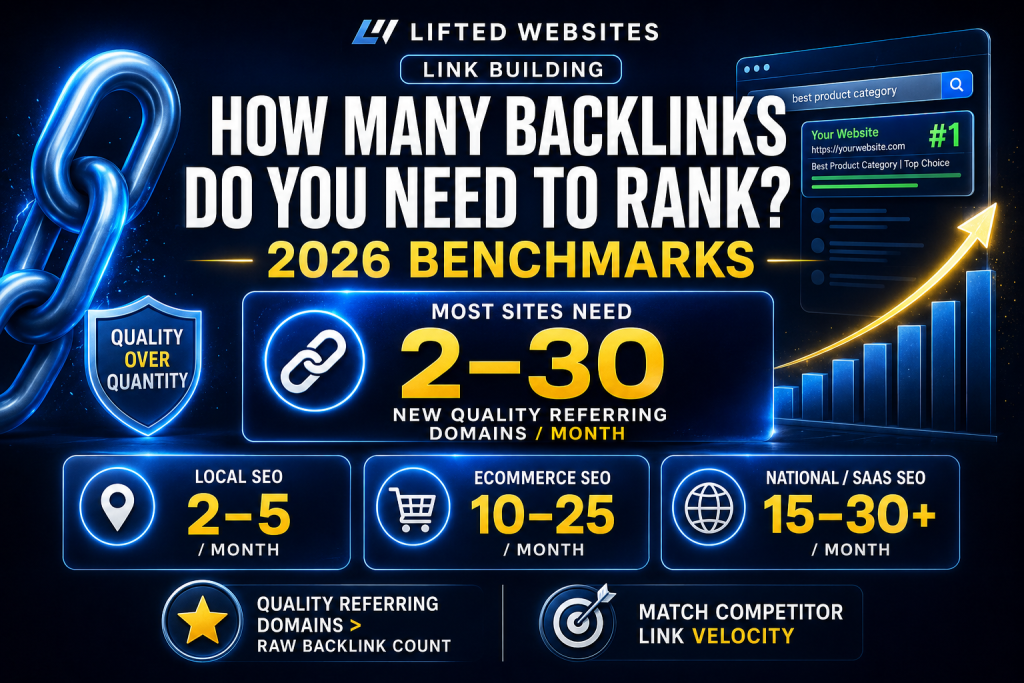
That said, healthy monthly acquisition rates cluster into clear ranges by business model:
| Campaign Type | Monthly Target | What Matters Most |
|---|---|---|
| Local SEO | 2–5 | Geo + industry relevance over raw DR |
| Ecommerce SEO | 10–25 | Homepage authority + category page links |
| National / SaaS | 15–30+ | Velocity must beat your top 5 competitors |
| Brand-New Site | 1–5 | Natural ramp — sudden spikes look artificial |
These ranges count referring domains — links from unique websites — not raw backlinks. Ten links from one site pass a fraction of the trust that ten links from ten relevant sites do, and Ahrefs’ research shows referring domains are what correlate with organic traffic.
Google’s systems and AI search summaries heavily favor brand trust and topical authority. 50 low-grade links can get a site filtered. 5–10 relevant, editorially placed links can transform rankings. If you have to choose, always choose fewer, better links.
What Is Link Velocity?
Link velocity is the rate at which a website gains new backlinks and referring domains over time. Google doesn’t evaluate your link count as a static number — it evaluates the pattern: how fast links arrive, where they come from, and whether that pace makes sense for your site’s size, age, and publishing output.
This is why a static goal like “exactly 10 links a month, forever” is the wrong frame. A healthy campaign runs on two principles instead:
The benchmark to anchor on: Ahrefs found top-ranking pages gain followed links from new websites at roughly 5–14.5% per month. That’s the pace of the winners — and content output is half the equation, which is why link building and content marketing have to be scoped together, not as separate line items.
Benchmarks by Campaign Type
For local markets, volume is low but relevance must be hyper-specific. A DR 25 link from your city’s chamber of commerce beats a DR 70 link from an unrelated national blog, because local rankings lean on Google Business Profile signals, reviews, citations, and proof that real local entities vouch for you. Best link types:
- Local sponsorships — little league teams, charities, community events
- Chambers of commerce and legitimate business associations
- Hyper-local news — expert quotes, community stories, local data
- Local partnerships and high-quality citations on real directories
This is the exact profile we build inside our local SEO services — a small, steady stream of genuinely local links paired with citation and review work.
Ecommerce needs a dual approach: high-authority links to the homepage to raise the tide of the whole domain, plus contextual links to category pages to pass equity to the URLs that convert. Product pages rarely attract links naturally — nobody links to a product listing — so equity has to be earned by linkable assets and routed internally. Best link types:
- Product review roundups and “best of” listicle placements
- Lifestyle blog gift guides — seasonal campaigns compound here
- Unlinked brand mention reclamation — the cheapest links you’ll ever get
- Niche resource pages in your product vertical
The most competitive landscape in SEO. To compete against massive corporate domains, your velocity must match or exceed your top five SERP competitors — so this tier starts at 15 placements per month with no real ceiling in finance, legal, or software. The constraint is outreach capacity, not a Google limit — which is exactly why agencies without an in-house outreach team run this tier through our white label link building program. Best link types:
- Digital PR campaigns — original data or surveys pitched to journalists
- High-tier guest features on publications with real editorial standards
- Original research assets that aggregate links passively over time
The 3-Part Quality Backlink Test
A quality backlink comes from a website with real organic traffic, topical relevance to your business, and genuine editorial standards. Every benchmark in this guide assumes links that pass all three tests — links that fail don’t count toward your number, no matter what the invoice says.
Does the linking site earn real organic traffic? High DR with zero Google traffic = link farm or repurposed expired domain. Google already discounted it. Walk away.
The linking page’s context must naturally relate to your business. A food blog linking to an industrial logistics site looks unnatural because it is. Relevance is the signal.
If anyone can buy a placement for $50 with no review, Google likely discounts every link on the site. Editorial gatekeeping makes a link a vote instead of an ad.
Ahrefs’ outreach study found the average asking price for a paid placement is around $361 per link. So when a vendor offers “50 backlinks for $99,” you already know what you’re buying. Links are usually the biggest line item in how much SEO costs.
How to Calculate How Many Backlinks You Need Per Month
To calculate your monthly backlink target, measure the referring domain growth rate of your top SERP competitors and set your pace to match or exceed it. Here’s the exact process:
For your primary keyword, note each one’s total referring domains in Ahrefs or Semrush.
Check each competitor’s referring domain history and average their new domains per month. This is your real benchmark — not a generic industry number.
If competitors average 12 new referring domains a month and you’re gaining 3, that 9-domain gap is your minimum target just to stop losing ground.
Links pointing at a static site look manufactured. Links arriving alongside genuinely useful new pages look earned — because they are.
Run every new link through the 3-part test. Keep anchors diverse and mostly branded — over-optimized exact-match anchors at any velocity are riskier than slow growth.
How Many Backlinks Should a Website Have in the AI Search Era?
In the AI search era, the number of backlinks a website has matters less than the strength of the brand those links build. ChatGPT, Perplexity, and Google’s AI Overviews cite sources they trust — and that trust is built from the same raw material as rankings: editorial links from real, relevant sites, brand mentions, and demonstrated authority.
This pushes the quality-over-quantity math even further. A hundred links from sites no human reads do nothing for AI citation — answer engines surface entities the credible web already talks about. Five editorial placements that put your brand next to your expertise do double duty: they pass ranking equity in classic Google and reinforce the brand signals that generative engine optimization is built on.
If your strategy still measures success in raw link counts, it’s optimizing for the 2015 version of search while competitors get cited by the answer engines your customers actually use. That’s the premise behind our AI SEO services: build authority both algorithms and AI models recognize.
These monthly link velocity benchmarks (Local: 2–5 · Ecommerce: 10–25 · National/SaaS: 15–30+) are free to reference in your own content — just link back to this page as the source.