⏱ 10 min read
📅 Updated May 21, 2026 — 4:30 PM PDT (Day 1)
Google Partner · 17+ years tracking Google core updates from Panda through May 2026
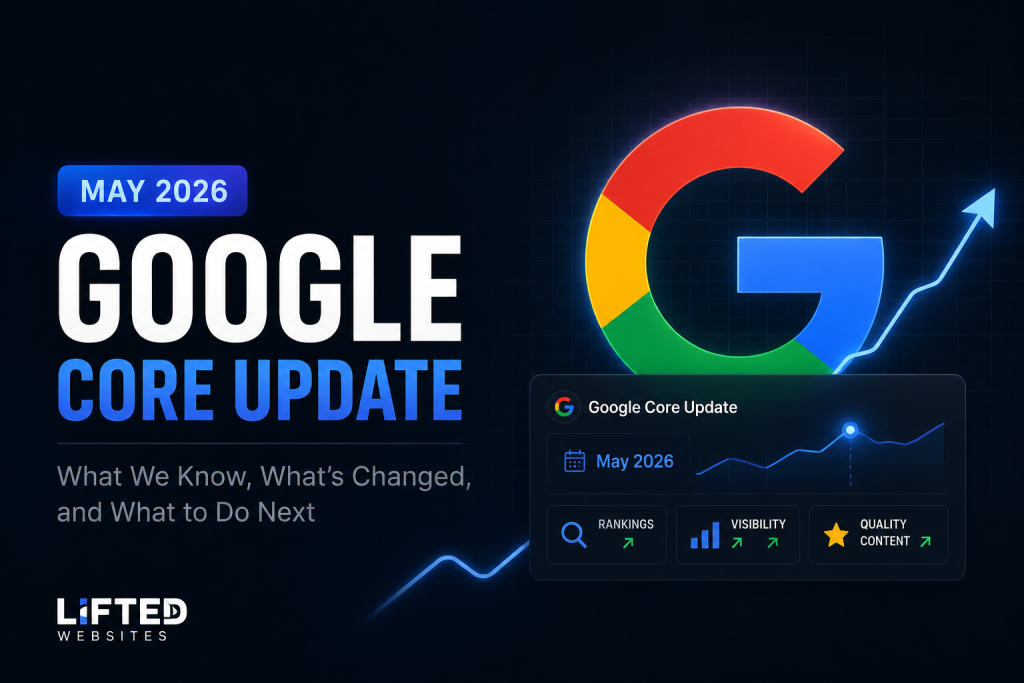
The May 2026 Google core update began rolling out at 08:40 AM Pacific Time on May 21, 2026, and Google says the rollout may take up to two weeks to complete. This is the second core update of 2026 and arrives just two days after Google unveiled the most significant Search redesign in its 25-year history at I/O 2026. That timing is not coincidental.
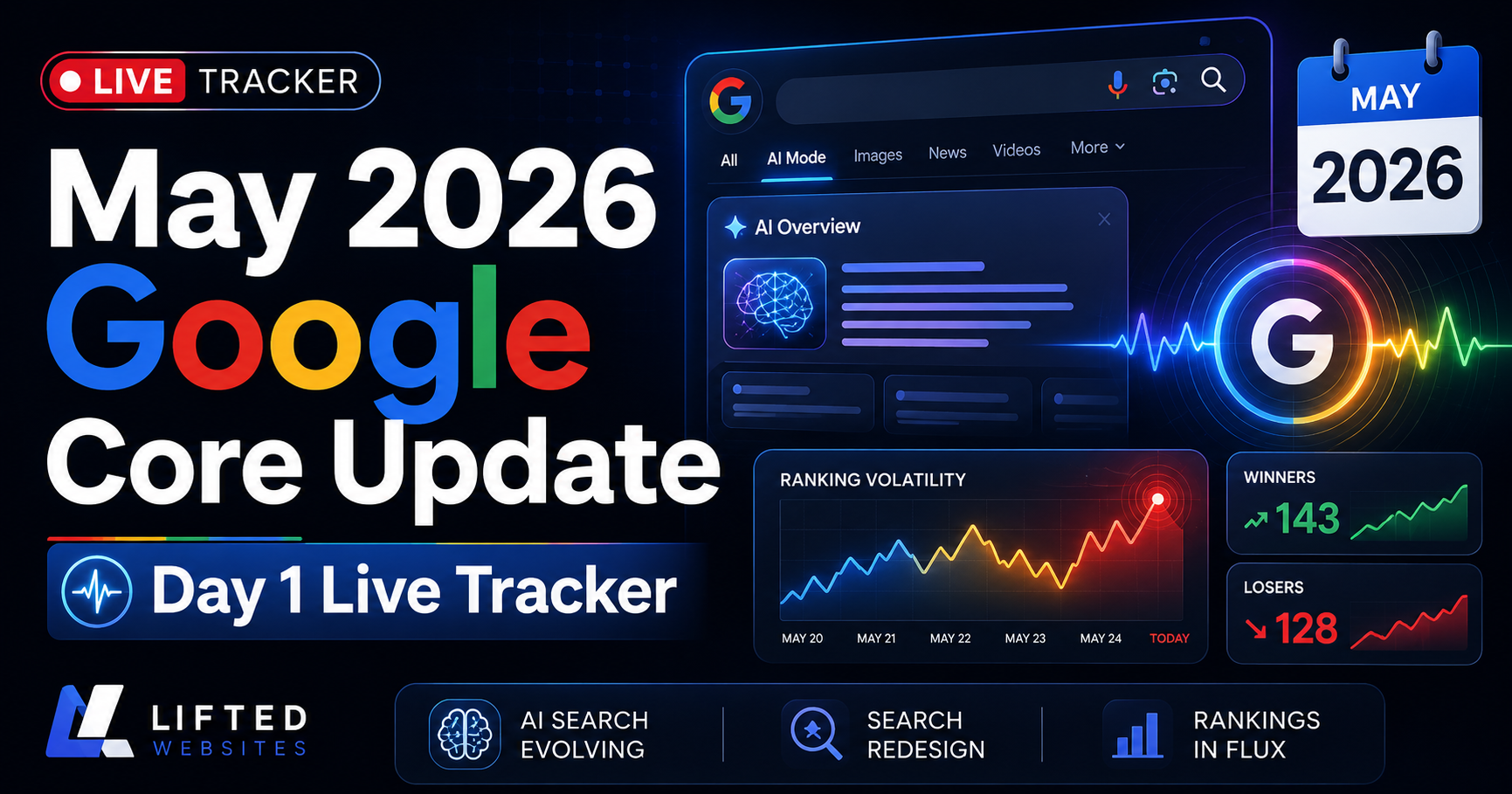
This page is a live tracker — what we know on Day 1, what we don’t, and exactly what to do (and not do) in the first 72 hours while the update is still rolling out.
May 21, 2026 PDT
rollout duration
of 2026
Search redesign
What We Know About the May 2026 Google Core Update So Far
The May 2026 core update is, in Google’s own words, “a regular update designed to better surface relevant, satisfying content for searchers from all types of sites.” That phrasing is the same boilerplate Google used for the March 2026 update, and it tells us almost nothing about what changed. Here is what we actually know on Day 1.
Confirmed timeline
Verified
Google’s Search Status Dashboard logged the release at 08:40 AM Pacific Time on May 21, 2026, with the Search Central account confirming on X at 11:43 AM Eastern. The dashboard entry states the rollout may take up to two weeks. Based on the last four core updates, the actual rollouts have ranged from 6 to 23 days — the March 2026 core update took 12 days and 4 hours to complete.
No companion blog post
New normal
Google did not publish a guidance post alongside the announcement. This matches the approach Google took with the March 2026 update and is the new pattern for 2026 core updates. No new guidance means the existing creating helpful, reliable, people-first content document remains the official reference.
No simultaneous spam update
Cleaner diagnosis
Unlike March 2026 — which paired a spam update (March 24–25) with the core update (March 27–April 8) — the May 2026 rollout is currently a standalone core update. This is operationally significant: ranking attribution is cleaner because only one algorithm change is moving the SERPs.
It follows two days of confirmed I/O search changes
High impact
Google announced a fundamental Search redesign at I/O 2026 on May 19–20. The core update launching 48 hours later is almost certainly the ranking-system half of that redesign — the changes I/O announced for the user interface need ranking changes underneath to populate them.
Volatility was already elevated pre-announcement
Community signal
Multiple SEO trackers reported intense SERP volatility starting May 19, two days before the formal announcement. Several practitioners called the early rollout before Google confirmed it. The community pattern of “I think this started days ago” matches what we saw in March 2026 and December 2025.

How the May 2026 Update Connects to the I/O 2026 Search Redesign
This is the most underreported angle on the May 2026 update, and it’s the lens that makes the timing make sense. At I/O 2026, Google announced what executives called “the most radical redesign of Search in its history” — a generative-first interface that surfaces AI-generated answers, source pages, and follow-up prompts as the primary result format on a wide range of queries.
A redesigned Search front-end needs a recalibrated ranking system underneath it. The pages that surface as citations inside AI-generated answers are not chosen by the AI freely — they are chosen by the same ranking signals that produce the organic ten blue links, weighted differently. When Google changes which sites get cited in AI Overviews and AI Mode, it does so by changing the underlying ranking system. The May 2026 core update is the ranking-system half of the I/O 2026 redesign.
Three practical implications follow from this for any site owner during the rollout:
- The update is almost certainly weighted toward signals that improve AI answer quality — clear factual sentences, structured data, entity authority, and information gain — because those are exactly the inputs an AI summarizer needs to assemble a good answer.
- Sites that were performing well in AI Overviews going into the update are likely to perform well in organic after it.
- The most useful diagnostic during this rollout is not just Search Console — it’s checking whether your pages still get cited in ChatGPT Search, Perplexity, and Google AI Overviews for the queries you care about.
The May 2026 core update is not separate from the AI Search era. It is the algorithmic foundation of it.
The 2026 Google Update Timeline in Context
Four confirmed ranking-system changes have rolled out in 2026 in under five months. The pattern is denser than any prior year. Use this table to attribute any ranking drop to the correct update, which is the single most important diagnostic step.
Two patterns matter from this table. First, the May 2026 update launched approximately six weeks after the March 2026 core update completed — a faster cadence than the 2024–2025 norm of 90–180 days between major updates. Second, this is the first 2026 core update without a simultaneous spam update, which makes diagnosis cleaner but means Google is not currently using the rollout to also target manipulation tactics.
What To Do in the First 72 Hours (And What Not to Do)
The single most expensive mistake you can make during a core update rollout is making major content changes based on early ranking movement. Google has been explicit on this for years: wait at least one full week after rollout completion before drawing conclusions. With a two-week rollout, that means your real diagnostic window opens around June 11, 2026.
In the meantime, here is the operator framework for the first 72 hours.
📅 Day 1 (May 21–22) — Baseline everything
- Export your Google Search Console performance data covering the 28 days ending May 20 and save it. This is your pre-update baseline.
- Pull your current Ahrefs and SEMrush rankings for your top 20 commercial keywords and save the snapshot.
- Screenshot your AI Overview presence for your top 5 commercial queries (run them in Google logged-out and incognito; check ChatGPT, Perplexity, and Gemini for the same queries).
- Note any major content publishing or deletion activity from the past 90 days so you have correct attribution if rankings move.
📅 Day 2 (May 22–23) — Watch, don’t act
- Check the Search Status Dashboard daily for rollout completion or notes.
- Track SEMrush Sensor daily and note the volatility peaks.
- Read the early industry coverage critically — most published analysis in the first 72 hours of a core update is speculative pattern-matching.
- Do not publish urgent “recovery” content. Do not delete pages. Do not change titles or H1s on pages that are still ranking.
📅 Day 3 (May 23–24) — Plan, don’t execute
- If you spot a clear ranking drop, identify the affected URL cluster and ask three questions before changing anything: Is this content the most genuinely useful page on the web for this query? Does it include information gain not already in the top results? Is the author identity established as a real entity across the web?
- Begin drafting a content quality improvement plan, but do not deploy changes until the rollout completes plus one week.
⛔ The “Do Not Do” List — Day 1 Mistakes That Make Recovery Harder
- Do not rewrite top-ranking pages because they dropped two positions.
- Do not delete entire content categories based on three days of data.
- Do not buy backlinks to “compensate” for a drop.
- Do not roll back recent legitimate content quality changes.
- Do not make any sweeping technical SEO changes during the rollout.
Likely Winners and Losers Based on the March 2026 Precedent
We do not yet have Day 1 winner-loser data for May 2026. What we do have is the March 2026 pattern, which Google has not signaled it is reversing. Sites that won in March 2026 are unlikely to be the primary losers in May 2026, and vice versa. The May update is more likely to deepen the March pattern than to overturn it.
Two specific signals to track in the first week as Day 1 data accumulates: whether sites that gained heavily in March 2026 hold those gains, and whether the I/O 2026 redesigned interface starts surfacing different citation patterns than the pre-update AI Overviews. If either pattern breaks from the March precedent, this update is doing something genuinely new — and we will document it in the next update of this tracker.
How to Track AI Search Impact Alongside Organic Rankings
Tracking the May 2026 core update through Search Console alone is insufficient. The update is happening simultaneously across Google organic, Google AI Overviews, Google AI Mode (the I/O 2026 interface), ChatGPT Search, Perplexity, and Gemini. Sites can hold organic positions while losing AI citations, or gain AI citations while losing organic — these are increasingly independent signals.
The minimum monitoring stack for the next 30 days:
- Google Search Console — clicks and impressions by query and page, with the May 21 date filter applied for before-and-after comparison.
- Ahrefs Rank Tracker — desktop and mobile positions for your top 50 keywords with daily refresh.
- SEMrush Position Tracking + AI Overview tracker — confirms which of your tracked keywords trigger AI Overviews and whether you are cited.
- Manual ChatGPT Search test — once per week, query your top 10 commercial keywords in ChatGPT Search and document whether your domain appears as a cited source.
- Manual Perplexity test — same protocol, weekly.
- Manual Gemini test — same protocol, weekly.
The sites that come out of the May 2026 rollout strongest will be the ones that audit all six channels, not the ones that look at Search Console alone and conclude they are fine.
Frequently Asked Questions: May 2026 Google Core Update
When did the May 2026 Google core update start?
The May 2026 Google core update began rolling out at 08:40 AM Pacific Time on May 21, 2026, according to the Google Search Status Dashboard. Google’s Search Central account confirmed the launch on X at 11:43 AM Eastern. The rollout is expected to take up to two weeks to complete.
How long will the May 2026 core update take to roll out?
Google has stated the rollout may take up to two weeks. The four most recent core updates have ranged from 6 to 23 days, with the March 2026 core update completing in 12 days and 4 hours. Based on that precedent, a completion date in early June 2026 is the most likely outcome — but the dashboard is the authoritative source.
Is the May 2026 update connected to the Google I/O 2026 Search redesign?
The May 2026 core update launched two days after Google announced a major Search redesign at I/O 2026 on May 19–20. While Google has not officially linked the two, the timing is consistent with a coordinated rollout: the I/O announcement reframes the user interface, and the core update recalibrates the ranking system that populates it. Site owners should expect the update to favor signals that improve AI answer quality, including structured data, clear factual sentences, entity authority, and information gain.
What should I do if my rankings drop during the May 2026 core update?
Do nothing immediately. Google’s official recommendation is to wait at least one full week after the rollout completes before drawing conclusions from Search Console data. Save a baseline snapshot of your current rankings, traffic, and AI Overview presence on Day 1. Track changes daily but do not make content edits, deletions, or rewrites during the active rollout. Major content changes during a core update typically make recovery harder, not easier.
Did the May 2026 update penalize AI-generated content?
There is no official confirmation either way, and Google has consistently stated that AI-generated content is not penalized as a category. The March 2026 core update treated AI content the same way it treated all content: original, expert-edited, and information-rich content performed well regardless of whether AI was involved in producing it, while mass-published unedited content lost ground regardless of whether it was AI-written or human-written. The May 2026 update is likely to follow the same pattern.
How can I tell if I was hit by the May 2026 core update?
A drop that begins on or after May 21, 2026 and is broader than a single page or query cluster is consistent with core update impact. A drop that began before May 21 may be related to the pre-rollout volatility many trackers observed starting May 19, but Google considers May 21 the official launch date. Compare your Search Console data from the 28 days before May 21 against the period after. If multiple unrelated pages dropped simultaneously, that is the core update pattern. If a single page or topic dropped, the cause is more likely a content-specific issue.
Will my rankings recover automatically after the May 2026 update completes?
Some will. Google has stated that pages negatively affected by a core update can recover between updates if the underlying content is genuinely strong, particularly if the volatility was caused by Google testing different ranking arrangements. However, if the algorithm has reassessed your content quality, authority, or relevance and found it wanting compared to competing pages, automatic recovery is unlikely. The most significant recovery typically occurs at the next major core update — expected sometime in late summer or fall 2026 — after meaningful content quality improvements have been deployed.
📡 What’s Next: Update Schedule for This Page
This is a living tracker. We will update this page at the following milestones:
- Within 48 hours of Day 1 — initial Day 3 SEMrush Sensor reading and any community-level data emerging
- Day 7 (approximately May 28) — mid-rollout volatility report and any official Google guidance
- Within 48 hours of Google’s rollout-complete announcement — full winners and losers analysis with first-party data from our client portfolio
- One week after rollout completion — definitive ranking-recovery playbook for affected sites
For real-time tracking, the Google Search Status Dashboard is the authoritative source. The Search Engine Land core update coverage and Search Engine Journal report are the most reliable industry coverage in the early days.
The Sites That Win This Update Are the Ones That Were Ready Before It Launched.
Lifted Websites builds content architectures and AI-ready SEO campaigns engineered for the ranking criteria this update is rewarding — information gain, topical authority, named expert authorship, and multi-channel visibility across Google, AI Overviews, ChatGPT Search, and Perplexity. We’re tracking the May 2026 rollout in real time across our client portfolio.
✓ AI search visibility tracking
✓ Information Gain content strategy
Related Reading
- → March 2026 Google Core Update: What Actually Changed — the predecessor update analysis
- → How to Rank in Google in 2026 — the 2026 ranking playbook
- → AI SEO Services — built for the AI Overview + ChatGPT + Perplexity era
- → Generative Engine Optimization (GEO) — get cited by AI
- → Local SEO Ranking Factors 2026
- → Best Local SEO Services in Scottsdale + Phoenix
- → SEO Blog Writing That Earns Topical Authority