Local SEO • 2026
⏱ 14 min read
📅 Updated April 2026
Google Business Profile Updates Killing Your Calls in 2026: The Map Pack Shift Nobody Warned You About
The Bottom Line
Google is quietly removing the one-tap “Call” button from the organic Local Pack on mobile, forcing customers through an extra click to reach your business. The change isn’t a glitch — it’s a deliberate push toward Local Services Ads. Here’s exactly what changed, what the data shows, and the eight-pillar recovery framework we use to keep client phones ringing without surrendering the budget to Google Ads.
If your phone has gone quieter in the last 90 days and your Google Business Profile insights look the same, you’re not crazy. The latest Google Business Profile updates have removed the one-tap call button from the mobile Local Pack — the three-result map block that 46% of all Google searches rely on for local discovery. Customers who used to dial you in a single tap now have to click into your full profile, scroll, and tap again. Every extra step strips off another slice of intent.
This isn’t a bug. It’s a business decision — and it rewards companies that know how to adapt.
46%
of Google searches have local intent
+1 Tap
added to organic call path
87%
of consumers use Google to evaluate local businesses
$600
average CPC for “google local services ads”
What Actually Changed in the Google Map Pack
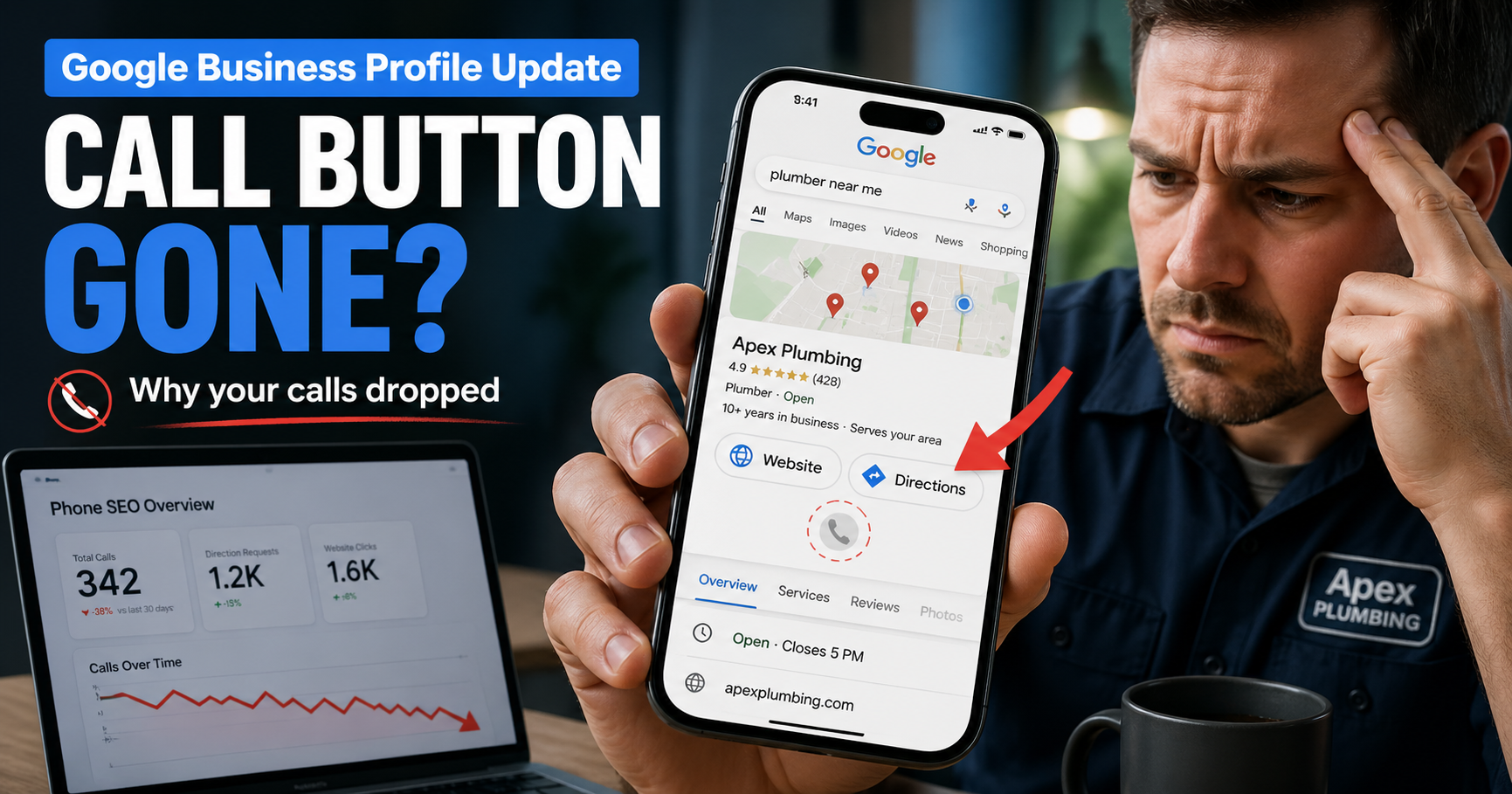
The Google Map Pack is the three-result map module that appears at the top of mobile and desktop search results for queries with local intent. For a decade, each of those three organic results displayed a one-tap blue “Call” button directly inside the pack. That button is now gone — or in heavy A/B testing — across most U.S. mobile devices as of early 2026.
In its place, Google is surfacing “Directions” and “Website” buttons inline, while routing the call action behind a profile click. Local Services Ads (LSA) and Call-Only Google Ads still keep the one-tap call button — they just sit above the organic pack in paid placements. The structural change is small in pixels and enormous in consequence.
Key Insight
A single added tap reduces conversion rate by an estimated 8–22% in mobile-first verticals like home services, healthcare, and legal. For a plumber doing 200 calls/month from the map pack, that is 16–44 lost leads — every month — until you adapt.
The Old vs. New Customer Journey
Before 2026
Search → See map pack → Tap “Call” → Phone rings. 2 taps total.
After 2026
Search → See map pack → Tap business name → Profile loads → Tap “Call” → Phone rings. 4 taps total.
Why Google Is Reshaping Local Business Leads
Google’s official explanation cites “user experience improvements” and reducing accidental pocket-dials. The honest explanation is revenue. Google Local Services Ads carry an average $600 CPC in our market data, and every organic call that converts is a paid call that didn’t happen. By adding friction to the free path, Google increases the perceived value — and click-through rate — of the paid path sitting directly above it.
There is also a longer-term play. Google is steadily transforming the map pack from an organic discovery surface into a transactional booking surface. “Book Online,” “Get Quote,” and “Reserve” buttons are getting pushed harder than the call button ever was. Businesses that integrate scheduling directly into their Google Business Profile are seeing rising CTR while everyone else watches their phone calls drop.
Who Gets Hit Hardest
🔧
Home Services
Plumbers, HVAC, electricians, roofers — verticals where 70–85% of revenue comes from inbound phone calls.
⚕️
Healthcare
Dentists, urgent care, chiropractors, vets. High-urgency searchers who won’t tolerate friction.
⚖️
Legal & Pro Services
Attorneys, CPAs, real estate. Single-call deals worth thousands — a dropped tap costs real money.
Part 1 — The Recovery Framework
8 Ways to Beat the Google Business Profile Updates Without Buying Ads
The exact playbook we use for clients in Phoenix, Scottsdale, and nationally.
You don’t have to surrender your marketing budget to Google to keep the phones ringing. The eight tactics below are listed in priority order — start at the top and work down based on your time, budget, and vertical. Every item here we’ve personally implemented for clients losing organic calls in the last six months.
01
Add a Booking Button to Your Profile (Highest ROI Move)
PRIORITY
Google now elevates “Book Online” and “Request Appointment” buttons above the call button on most profiles. Connecting a supported scheduler — Booksy, Square Appointments, Vagaro, Mindbody, or a Reserve with Google partner — surfaces a one-tap action button in the Local Pack. This is the single biggest lever to recover the action-button real estate Google just took away.
Best for: Healthcare, salons, restaurants, professional services, fitness studios.
02
Turn Your Mobile Site Into a Call Machine
Since users now click into your profile and often onward to your site, the mobile site has to do the work the map pack used to do. Sticky “Call Now” header that follows scroll. Click-to-call links on every phone number. Largest Contentful Paint under 2.5 seconds. A single second of additional load time drops conversions by 7%. If your website design hasn’t been audited for mobile call conversion in the last 12 months, you’re leaking leads through three different holes simultaneously.
03
Install Real Call Tracking (Stop Trusting Google’s Numbers)
Google Business Profile insights are now an unreliable narrator. Calls are shifting from the map pack to your website, but GBP only counts the calls placed through its own buttons. Third-party call tracking (CallRail, CallTrackingMetrics, WhatConverts) attributes every call to its true source — including the ones GBP no longer reports. Without it, you’ll cut a campaign that’s actually working because the dashboard tells you a lie.
04
Win the Map Pack Itself (Position Matters More Than Ever)
When friction increases, ranking position #1 in the local pack matters more — not less. CTR drops sharply between positions 1 and 3 in the new layout, and position 4+ (the “see more” results) gets almost nothing. Reviews velocity, GBP category accuracy, citation consistency, and proximity-relevance signals all matter. We covered the full ranking checklist in our guide to ranking in the Google Maps top 3.
05
Run Defensive Local Services Ads (Selectively)
If a competitor is buying LSA placement above your organic listing, they are stealing the one-tap call action that used to be yours for free. A modest LSA budget — even $500–$1,500/month in most metros — can re-secure that placement. We treat this as a defensive line item, not the primary play. The unit economics only work if your average customer value justifies the $40–$120 cost per LSA lead in your vertical.
06
Optimize for AI Overviews and Generative Search
More local searches are getting answered inside AI Overviews and ChatGPT/Perplexity than ever before — and those answers cite a small number of sources. Generative engine optimization is no longer optional for local. Structured data, clear definition sentences, FAQ schema, and topical authority all increase the odds your business gets cited when the AI answers “Best plumber near me” — bypassing the map pack entirely.
07
Diversify Off Google Entirely
Apple Maps Business Connect, Bing Places, Yelp, Nextdoor, and category-specific directories (Houzz for remodelers, Avvo for attorneys, Healthgrades for medical) are all generating real call volume in 2026. iPhone share alone justifies Apple Maps optimization. Build a portfolio of discovery surfaces so a single Google policy change can never dictate your monthly revenue again.
08
Build a Reviews Engine That Compounds
In a higher-friction map pack, social proof becomes the deciding factor before someone clicks into your profile. A business with 247 reviews at 4.8 stars beats a 4.9-star competitor with 38 reviews almost every time. Automate review requests after every completed job. Respond to every review. Bake review keywords (“emergency”, “weekend”, “same-day”) into your replies — they feed the local relevance algorithm Google uses to rank you.
Part 2 — The Diagnostic
How to Tell If the Google Business Profile Updates Are Hurting You
A 5-minute audit you can run before lunch.
Before you change a single thing, get the diagnosis right. Calls can drop for many reasons — seasonality, a new competitor, a Google ranking shift, a website outage, a phone number error. Run these five checks in order to isolate whether the call button removal is the actual culprit.
-
1
Compare GBP calls to website calls year-over-year.
Open GBP Insights → Calls (last 90 days vs. prior year). Then check your call tracking platform. If GBP calls are down but website calls are up by a similar amount, the friction shift is real and your traffic is just rerouting.
-
2
Check map pack views vs. profile clicks.
If profile views (impressions on the pack) are flat but website clicks and direction requests are rising while calls are falling, that’s the signature pattern of the call button being removed. Users are still finding you — they just can’t dial as fast.
-
3
Run a mobile SERP test in incognito.
Open your phone, go incognito, and search your top three keywords. Note which buttons appear inside the map pack. If you see “Directions” and “Website” but no “Call,” your customers are seeing the same thing.
-
4
Audit competitor LSA presence.
If two or three competitors now sit above the organic pack with Google Screened LSAs, they’re absorbing the one-tap call traffic that used to spread across the top three organic results. That’s a budget problem, not a ranking problem.
-
5
Check whether you have a “Book” button enabled.
Open your GBP and look at the action buttons available. If you don’t have Booking enabled, you’re missing the action button Google is now elevating above the call button. This is a 30-minute fix that often recovers 15–30% of lost lead volume.
Organic Map Pack vs. Local Services Ads: 2026 Reality Check
The most common reaction to the call button removal is “should I just buy LSAs?” The answer depends on your vertical, your average customer value, and your existing organic position. Local Services Ads are pay-per-lead placements above the map pack that include the one-tap call button Google removed from organic. Here is the honest comparison.
| Factor |
Organic Map Pack |
Local Services Ads |
Priority |
| One-tap call button |
Removed |
Yes |
High |
| Cost per lead |
$0 (organic) |
$25–$150 |
High |
| Position above pack |
No |
Yes (top placement) |
High |
| Trust signal |
Reviews + ranking |
Google Screened/Guaranteed badge |
Medium |
| Vertical eligibility |
All |
Limited (home services, legal, healthcare, real estate) |
Medium |
| Long-term ROI |
Compounds (rankings hold) |
Stops when budget stops |
High |
| Best use case |
Foundation of every local strategy |
Defensive top-of-page coverage |
High |
Pro Tip
The right answer is rarely “either/or.” Most of our clients run organic local SEO as the foundation and layer LSAs on top during peak season or in high-LTV verticals where one extra job pays for the month.
What This Means for Phoenix and Scottsdale Businesses Specifically
In Phoenix metro and Scottsdale, three categories show the steepest organic call drop in our client data: HVAC (driven by emergency searches that historically converted at 60%+ on map pack tap-to-call), personal injury law (where high-CPC keywords already pushed competitors toward LSAs), and dentistry/urgent care. The good news: Arizona has lighter LSA saturation than Los Angeles or Houston, meaning organic position #1 still produces meaningful call volume even with the friction increase.
If you’re running Phoenix local SEO or competing for Scottsdale SEO rankings, the playbook above gets you most of the way back to pre-2026 lead volume — usually within 60–90 days of implementation.
Google Business Profile Updates FAQ
Did Google really remove the call button from the local pack?
+
Yes. Google has begun rolling out a mobile Local Pack layout in 2026 that no longer surfaces a one-tap “Call” button on each of the three organic map results. Users now have to tap into the business profile first, then tap the call icon — adding a step that materially reduces call conversion rates. The change is live in most U.S. markets and continues to expand.
Why is my Google Business Profile not getting calls anymore?
+
The most common cause in 2026 is the call button removal from the mobile Local Pack. Calls are not gone — they have shifted to your website and to Local Services Ads competitors above your listing. Other causes include a recent ranking drop, a missing or wrong phone number, or competitors running LSAs above the organic pack. Run the five-step diagnostic above to identify which is hitting you.
Where do Google Business Profile updates show up?
+
Google Business Profile updates appear in three places: the GBP dashboard (under “Updates from Google”), the public-facing profile when users click your business name in Maps or Search, and inside Google’s official documentation at support.google.com/business. Google-suggested edits also appear in the dashboard for owner approval before going live.
Is Google Business Profile being discontinued?
+
No. Google Business Profile is not being discontinued. The standalone GBP web dashboard was retired in 2024, with management moved into Search and Maps directly, but the underlying profile system remains the foundation of local search. Recent 2026 updates have changed the user-facing layout (call button removal, booking elevation, AI-generated content suggestions) but the platform itself is more central to Google’s strategy than ever.
How do I get on the Google Map Pack in 2026?
+
To rank in the Google Map Pack, optimize five core signals: complete and accurate Google Business Profile (primary category, services, hours, photos), proximity to the searcher, review volume and recency, citation consistency across the web, and on-site local relevance signals (location pages, schema markup, locally-relevant content). In 2026, review velocity and AI-citable content are the two fastest-rising ranking factors.
Are Local Services Ads worth it for small businesses?
+
Local Services Ads are worth it when your average customer lifetime value exceeds 3x your cost per lead and your service area has lighter LSA saturation. For HVAC, plumbing, roofing, and personal injury law in most metros, the math works. For low-ticket services or oversaturated markets, organic map pack ranking with strong reviews remains the better long-term investment. Run a 60-day test with a capped budget before committing.
How quickly can I recover lost calls after these updates?
+
Most of our clients recover 70–90% of lost organic call volume within 60–90 days when they implement the eight-pillar framework above in priority order. Adding a booking button and fixing mobile call conversion are the two fastest wins — both can show measurable lift inside two weeks. Defensive LSA budget produces same-day results but requires ongoing spend.
The Bottom Line on Google Business Profile Updates and Your Phone
Google is a public company with a $2T market cap, and every layout change is a deliberate move to monetize attention. The free ride of the one-tap map pack call button is over. The businesses that win in 2026 won’t be the ones who complain — they’ll be the ones who diversify their lead capture, modernize their mobile site, install real call tracking, and treat the Google Business Profile as one channel inside a portfolio rather than the entire business.
If your call volume is down and you don’t yet know why, the worst move is to wait. Every month you operate on stale assumptions is a month a competitor catches you in the rankings or absorbs your placement with paid ads.
Stop Bleeding Calls
Get a Free Local SEO Audit From Lifted Websites
We’ll diagnose exactly why your calls dropped, benchmark you against your top three competitors, and hand you a 90-day recovery plan. No fluff, no contracts, no obligation.
✓ Map pack diagnosis
✓ Competitor breakdown
✓ 90-day plan
Get My Free Audit →
Trusted by businesses across Phoenix, Scottsdale, and the U.S. since 2018.