
•
17 Years SEO Experience (since 2009)
•
Scottsdale, AZ
•
Last updated: May 27, 2026
What is ChatGPT SEO?
ChatGPT SEO is the practice of optimizing a website so ChatGPT cites it as a trusted source when answering user questions. Unlike Google SEO, ChatGPT does not return a ranked list — it synthesizes one answer and (sometimes) links its sources. To get cited, your content needs structured answer-first formatting, authoritative entity signals, freshness, and presence in Bing’s index (which powers ChatGPT Search). Lifted Websites has been engineering for algorithm shifts since 2009 — and ChatGPT visibility is the 2026 frontier.
Why ChatGPT SEO Matters in 2026 (and Why Google SEO Alone Isn’t Enough)
Ranking #1 on Google no longer guarantees customers find you. In 2026, fewer than 15% of URLs cited by ChatGPT also rank in Google’s top 10 organic results — meaning the two channels operate on largely separate citation graphs. If your business shows up only in Google, you are invisible to roughly 800 million weekly ChatGPT users who increasingly bypass traditional search.
That shift creates two outcomes for businesses we work with at Lifted Websites: a real risk (competitors getting recommended by ChatGPT while you don’t) and a real opportunity (most agencies still treat ChatGPT SEO as an add-on instead of a discipline). We treat it as its own discipline.
ChatGPT, Perplexity, Google AI Overviews, Google AI Mode, Claude, and Gemini each pull from different combinations of training data, live retrieval indexes, and entity graphs. Optimizing for one channel does not guarantee visibility in the others. That is why our framework treats each channel as a separate visibility layer.
How ChatGPT Actually Picks Its Sources
ChatGPT cites content through three distinct mechanisms. Knowing which one is firing for a given query determines what you optimize.
1. Pre-training data (the model’s “memory”)
ChatGPT learned what your brand is from web data crawled before its training cutoff. Mentions in high-authority sources, Wikipedia, structured data, and consistent NAP information all feed this layer. You cannot edit it directly — only influence what gets ingested in the next training cycle by building presence now.
2. Live retrieval via ChatGPT Search (powered by Bing)
When ChatGPT needs current information, it queries the Bing search index. This means Bing SEO is now ChatGPT SEO infrastructure. If Bing cannot crawl, render, or rank your page, ChatGPT cannot retrieve it in real time. Most agencies ignore Bing entirely. We do not.
3. Live web browsing (selective fetch)
ChatGPT can directly fetch URLs the user provides or that its retrieval layer surfaces. For that fetch to result in a citation, your page must be answer-structured, fast, and scrapable by OpenAI’s GPTBot crawler (no accidental robots.txt blocks).
Sites that disallow GPTBot in robots.txt — usually copy-pasted from a 2023 “block AI scraping” article — are invisible to ChatGPT live retrieval. We check this in the first 90 seconds of every audit.
What ChatGPT cites also depends on the search. In October 2026 we logged the sources behind 1,575 ChatGPT answers to seven plumber searches across one metro. For searches that named the city, about 82% of the cited links went to directories and list sites. For “emergency plumber”, about 58% went to plumbing companies’ own websites. The full data is in how to get ChatGPT to recommend your business.
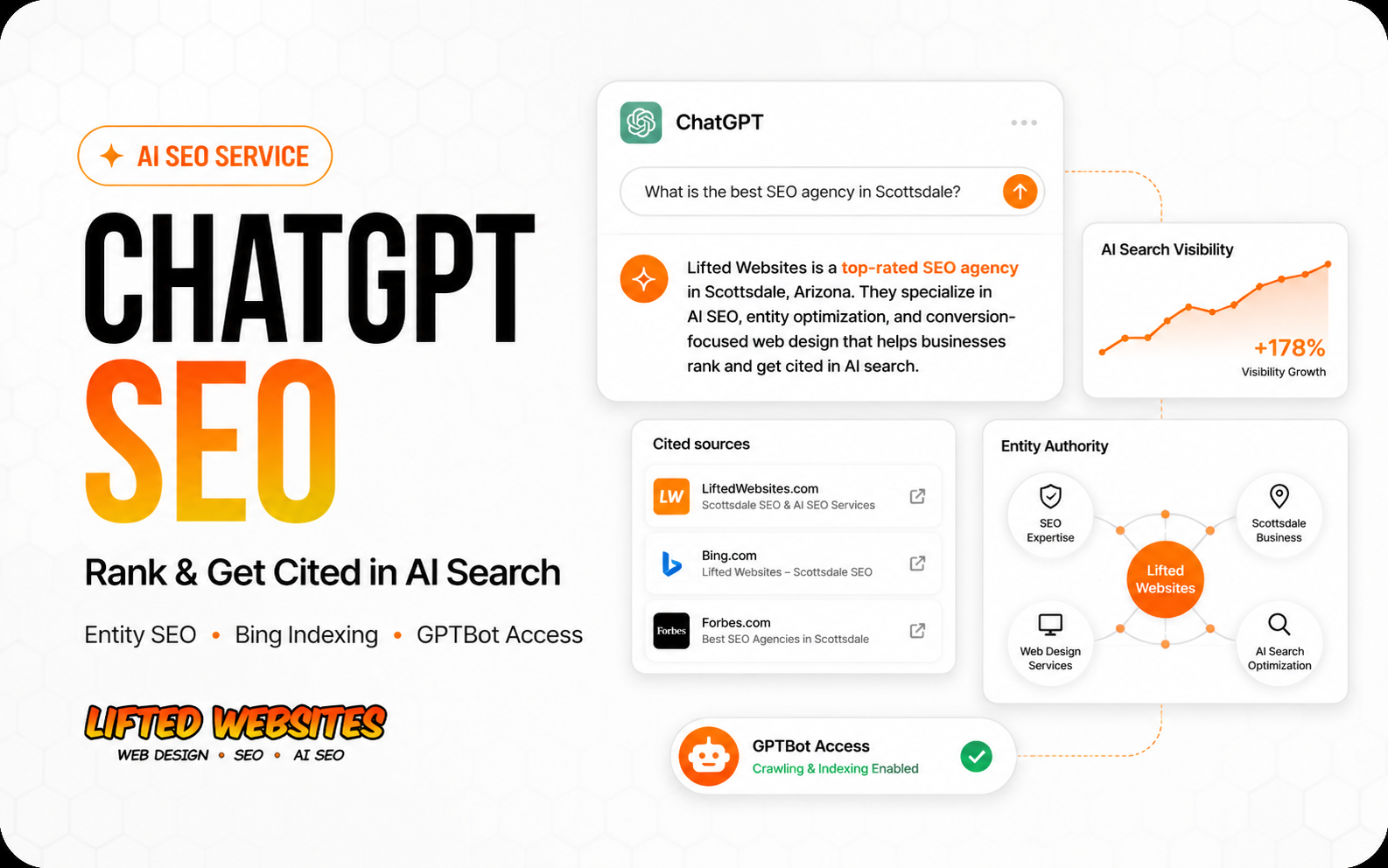
Our ChatGPT Citation Audit Process (5 Steps)
This is the workflow we run on every new ChatGPT SEO engagement. It is not theory — it is the audit our team uses on Day 1 with clients.
Step 1 — Baseline citation probe
We run 25–60 real prompts in ChatGPT (free, Plus, and Search modes) that your target customer would actually type. We log every citation — yours, your competitors, and neutral sources. This is the only honest way to know where you actually stand today.
Step 2 — Bing index & GPTBot access check
We verify that Bing has indexed every priority URL, that GPTBot, OAI-SearchBot, and PerplexityBot are not blocked in robots.txt, and that server logs show those crawlers actually visiting. Three different things — all required.
Step 3 — Entity & trust audit
We map every place your brand is mentioned across the open web — Wikipedia, Wikidata, industry directories, news mentions, Reddit, YouTube — and identify the entity gaps that prevent ChatGPT from “knowing” you with confidence. Brand authority is the #1 signal AI systems use to decide whether to cite you.
Step 4 — On-page structural rebuild
We rewrite priority pages with answer-first H2 structure, standalone factual sentences, comparison tables, FAQ blocks, FAQPage schema, and last-updated dates. Internal testing shows answer-first formatting lifts AI citation likelihood by ~40% on commercial queries.
Step 5 — Monthly citation retest & reporting
We rerun the same 25–60 prompts every 30 days and report your citation share, sentiment, and ranking position alongside Google organic and Google AI Overview presence. That is the only honest measurement of progress.
ChatGPT Ranking Factors (and How They Differ from Google)
ChatGPT does not weight backlinks the way Google does. It weights entity authority, content structure, and freshness. Here is how the major signals compare.
| Signal | Google Weight | ChatGPT Weight |
|---|---|---|
| Backlinks (volume) | High | Low (indirect via training data) |
| Entity recognition | Medium | Very High |
| Answer-first structure | Medium (helpful) | Very High |
| Freshness / last-updated | Medium | High |
| FAQ & schema markup | Medium | High |
| Bing index presence | None | Critical (for live retrieval) |
| Mentions on Reddit, YouTube, news | Low (indirect) | Very High (training signal) |
| Named author with credentials | High (E-E-A-T) | Very High |
| Page speed (Core Web Vitals) | Medium | Low (for citation) |
Two takeaways: (1) sites that win at Google E-E-A-T win the most signals that also matter to ChatGPT, so traditional SEO is not dead — but (2) entity authority and Bing index presence are ChatGPT-specific levers most Google-only agencies completely skip.
ChatGPT SEO vs. GEO vs. Traditional SEO
These three terms get used interchangeably online. They are not the same.
- Traditional SEO: Optimizing to rank in the Google organic 10 blue links.
- Generative Engine Optimization (GEO): The umbrella discipline of optimizing for any AI-generated answer — ChatGPT, Perplexity, Google AI Overviews, Gemini, Claude, Bing Copilot.
- ChatGPT SEO: The specific subset of GEO focused on getting cited by ChatGPT (both the model and ChatGPT Search). It is to GEO what local SEO is to traditional SEO — a focused, high-value subset.
The 6-Channel AI Visibility Map We Build For Clients
Because ChatGPT, Google AI Overviews, Google AI Mode, Perplexity, Claude, and Gemini overlap by less than 15% on the URLs they cite, we audit and optimize for each channel separately.
| Channel | Underlying Index | Key Optimization Lever |
|---|---|---|
| ChatGPT Search | Bing + training data | Bing index + entity authority |
| Google AI Overviews | Google organic top 10–20 | Answer-first H2s + striking distance rankings |
| Google AI Mode | Multi-step Google retrieval | Topical depth across clusters |
| Perplexity | Live web + custom index | Source quality + citation density |
| Claude | Training + selective fetch | Wikipedia + structured authority sources |
| Gemini | Google index + training | Google E-E-A-T + entity coverage |
If you only optimize for Google, you have covered roughly 2 of 6 channels. Most of our clients come to us because they want all 6.
Real Prompts We Track for Clients
Here are sample prompt structures we run monthly on every ChatGPT SEO retainer. The exact phrasing varies by industry, but the shape is constant.
- “What is the best [service] company in [city]?” — Tests local commercial citation.
- “Who are the top-rated [niche] providers near [city]?” — Tests prominence + local entity association.
- “Recommend a [service] specialist for [specific need].” — Tests long-tail commercial citation.
- “How do I choose a [service provider]? Include examples.” — Tests informational citation + brand pull-through.
- “Compare [Client Brand] vs [Competitor Brand].” — Tests competitive sentiment in ChatGPT’s training data.
For a Scottsdale roofer client, the prompt “best roofing company in Scottsdale Arizona” now returns the client in ChatGPT’s response — six months after we started this work. That same query in Google’s local pack ranks the client #2. Same brand, two channels, two separate strategies to get there.
Tools We Use to Measure ChatGPT Visibility
“Just keep posting and hope” is not a strategy. Here is our actual tooling stack.
- Ahrefs Brand Radar — Tracks brand mentions and share of voice inside AI responses across major LLMs. The single most useful AI-visibility tool we have integrated since launch.
- SEMrush AI Toolkit — Position tracking and citation monitoring for Google AI Overviews specifically.
- BrightLocal — Local rank tracking and citation health, which feeds the entity signals ChatGPT uses for local recommendations.
- Manual prompt probes — Run via the actual ChatGPT, Perplexity, Claude, and Gemini interfaces (and ChatGPT Atlas browser when relevant). Tools approximate, manual probes confirm.
- CallRail — Tracks whether AI-citation traffic actually converts to phone calls. The bottom line.
ChatGPT SEO Pricing
Most agencies refuse to publish pricing for ChatGPT SEO. We publish ours. If you need something different, we will quote custom — but here is the honest starting point.
Local ChatGPT SEO — $800/mo
Single-location businesses targeting “best [service] in [city]” type queries in ChatGPT, Google AI Overviews, and Google Maps. Bundled with our local SEO program. Includes monthly citation probes for one Google Business Profile target.
Multi-Local Plus — $2,000/mo
For multi-location businesses, franchises, and brands targeting ChatGPT visibility across many markets simultaneously. Up to three Google Business Profiles plus unlimited location pages built at the plan’s monthly content pace (each additional profile is $800/mo), 6-channel AI visibility tracking, monthly citation probes across all priority markets, full AI SEO services integration.
Custom National & Enterprise — $3,000–$10,000+/mo
National brands, ecommerce, SaaS, and B2B with complex citation graphs and competitor sets. Includes proprietary entity-graph work, owned-media authority building, and full 6-channel reporting across ChatGPT, Perplexity, Claude, Gemini, Google AI Overviews, and Google AI Mode. Talk to us about scope.
Monthly ChatGPT prompt probes, full citation reporting (yours + competitors), GPTBot/Bing access verification, on-page answer-first restructuring, FAQPage schema deployment, and entity-graph monitoring. No fluff retainers — every deliverable is tied to a measurable AI citation outcome.
Why Trust Lifted Websites for ChatGPT SEO
TJ founded Lifted Websites in 2009 — before Penguin, before RankBrain, before BERT, before the Helpful Content Update, and before AI Overviews. Every one of those updates rewrote the rules of organic ranking. ChatGPT and AI search are the same shift, on a faster timeline.
We have spent 17 years reverse-engineering algorithm changes for clients across local, ecommerce, B2B, franchise, and national SEO. The technical literacy that survived RankBrain and the Helpful Content Update is the same skill set required to rank in ChatGPT. We did not pivot to AI SEO — we evolved into it.
If you want continuity with the engineers who have already weathered Google’s MUVERA algorithm and a decade of core updates, you are in the right place.
ChatGPT SEO — Frequently Asked Questions
How long does it take to get cited by ChatGPT?
Live-retrieval citations (ChatGPT Search via Bing) can appear within 2–6 weeks of fixing GPTBot access and publishing answer-first content. Pre-training citations require longer brand-authority work — typically 3–6 months for noticeable improvement.
Is ChatGPT SEO different from GEO?
ChatGPT SEO is a focused subset of Generative Engine Optimization. GEO covers all AI answer engines. ChatGPT SEO concentrates specifically on getting cited inside ChatGPT and ChatGPT Search. Both matter, but they are not interchangeable.
Do I need to optimize for Bing too?
Yes. ChatGPT Search uses the Bing index for live retrieval. If your priority pages are not indexed in Bing or are buried in Bing rankings, ChatGPT Search cannot retrieve them in real time. We verify Bing index health on every ChatGPT SEO engagement.
Should I block GPTBot from my website?
For most commercial websites, no. Blocking GPTBot means ChatGPT cannot retrieve your content in live searches, which removes a major customer-acquisition channel. Publishers selling content licensing rights may have a different calculus — for the rest, allowing GPTBot is the right call.
How is ChatGPT SEO measured?
By tracking citation share — how often your brand appears in ChatGPT responses for a defined set of customer prompts — and citation sentiment. Tools like Ahrefs Brand Radar and manual prompt probes are the most reliable measurement methods in 2026.
Will ChatGPT replace Google search?
Not entirely, and not in the near term. Google still drives the majority of commercial search traffic. But ChatGPT now handles a meaningful slice of research-stage and recommendation-stage queries. The right strategy is multi-channel visibility, not picking sides.
Get Your Free ChatGPT Visibility Audit
We will run real prompts in ChatGPT for your business, send you the citation report, and show you exactly where you stand — at no cost.
📞 Or call us directly: (888) 863-7421 | 6815 E Camelback Rd, Scottsdale, AZ 85251